
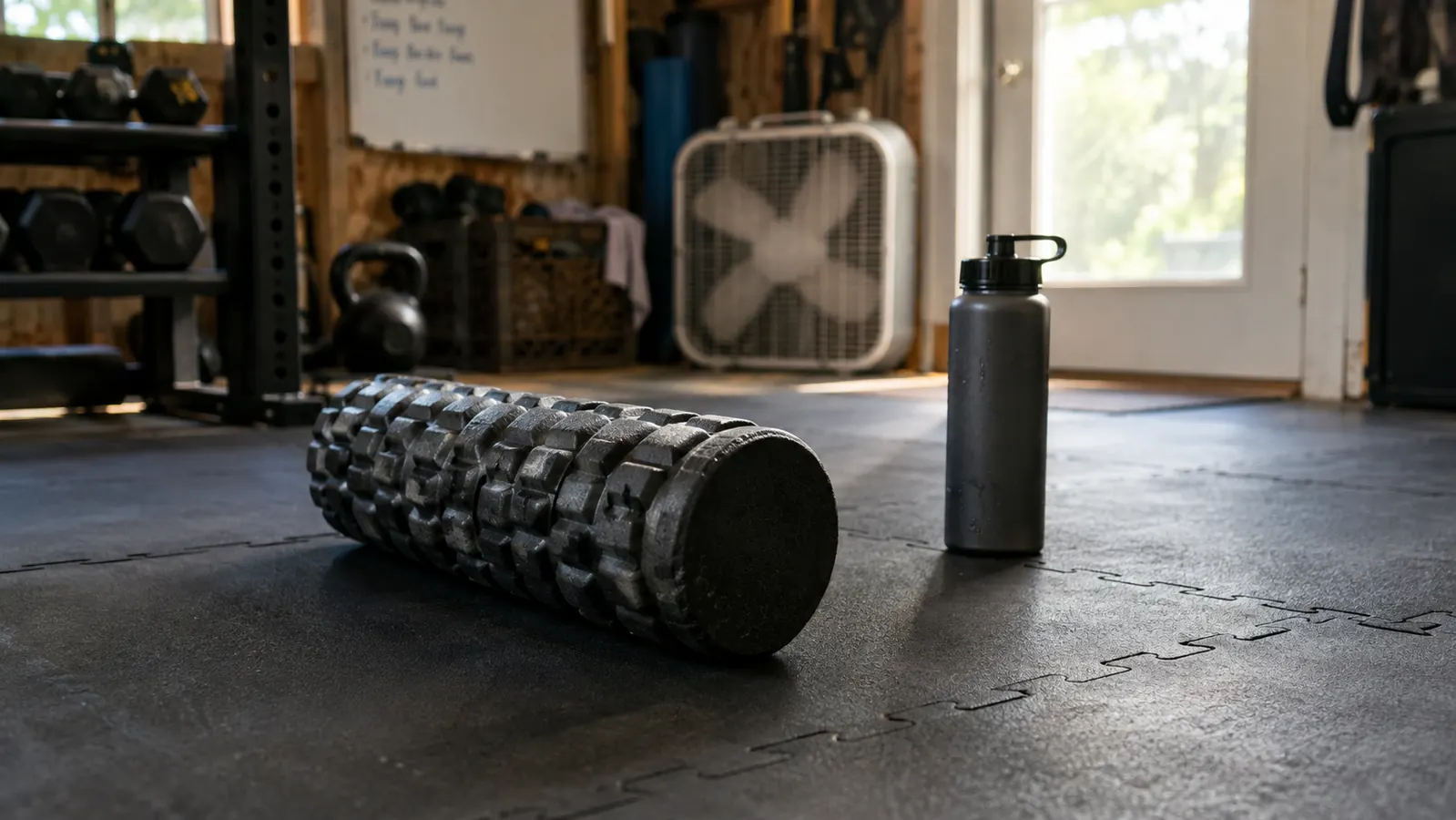
I did not want to like the TRIGGERPOINT GRID. I already owned a smooth foam roller that cost less than lunch, it had done fine by me for years, and I could not see what a strip of ridged foam was going to do that my old one could not. Then my right shoulder tightened up in the middle of a Saturday session and I could not get my arm overhead for the cool-down. That is the version of me that ordered the 13 inch GRID, grumbling, from the couch with a heating pad on my lap.
This is the honest review, which means it includes the parts the glowing write-ups skip. The GRID is extra firm. It has a three-dimensional surface of ridges and nodules that vary in density, so it does not feel the same under your quad as it does under your mid-back. That is the entire pitch, and it is also the entire problem, depending on who is holding it. I have used it three or four mornings a week for a full season in my garage, plus two evenings a week alongside my husband Ray, who is 58, has a bad left knee, and strong opinions about anything that hurts.
The Quick Verdict
Extra firm, well made, and genuinely useful on quads, calves and upper back. It is also unforgiving on a first pass, and it is honestly too much roller for someone who has never rolled before.
Amazon Check Today's Price →Firm Pressure, Small Footprint, Nothing to Charge
The 13 inch GRID is about 1.1 pounds of extra firm foam that stands in a corner when you are finished with it. Check today's price and the listed dimensions before you commit.
Amazon Check Today's Price on Amazon →What the GRID Actually Is, and What It Is Not
Strip away the packaging language and you have a foam cylinder. The 13 inch GRID weighs about 1.1 pounds, is made of foam, and carries an extra firm firmness rating. No motor, no battery, no heat, no app, and nothing to plug in. You put it on the floor and you get on top of it, and whether the session is any good depends entirely on how patient you are willing to be for the first three minutes.
What separates it from a plain roller is the surface. The GRID has a three-dimensional pattern of ridges and nodules that vary in density, which the listing calls Distrodensity Zones. In plain English, some of the surface is firm and some of it is firmer, and the gaps between the ridges give your muscles somewhere to sit. As you roll across it, the pressure changes without you doing anything clever, which is closer to what a massage feels like than a flat tube of foam is. That sounds like marketing and it is not. I can feel the difference within two passes.
I want to be clear about what it is not, because that is where people get disappointed. It is not a gentle roller. If you are picturing the soft half-round roller at the gym that you lie on and forget about while you check your phone, this is not that. The TRIGGERPOINT GRID is a firm tool that asks something of you on the first pass. If you are brand new to rolling, the first pass is going to be a conversation, and you are going to lose it.
How I Tested It in a One-Car Garage
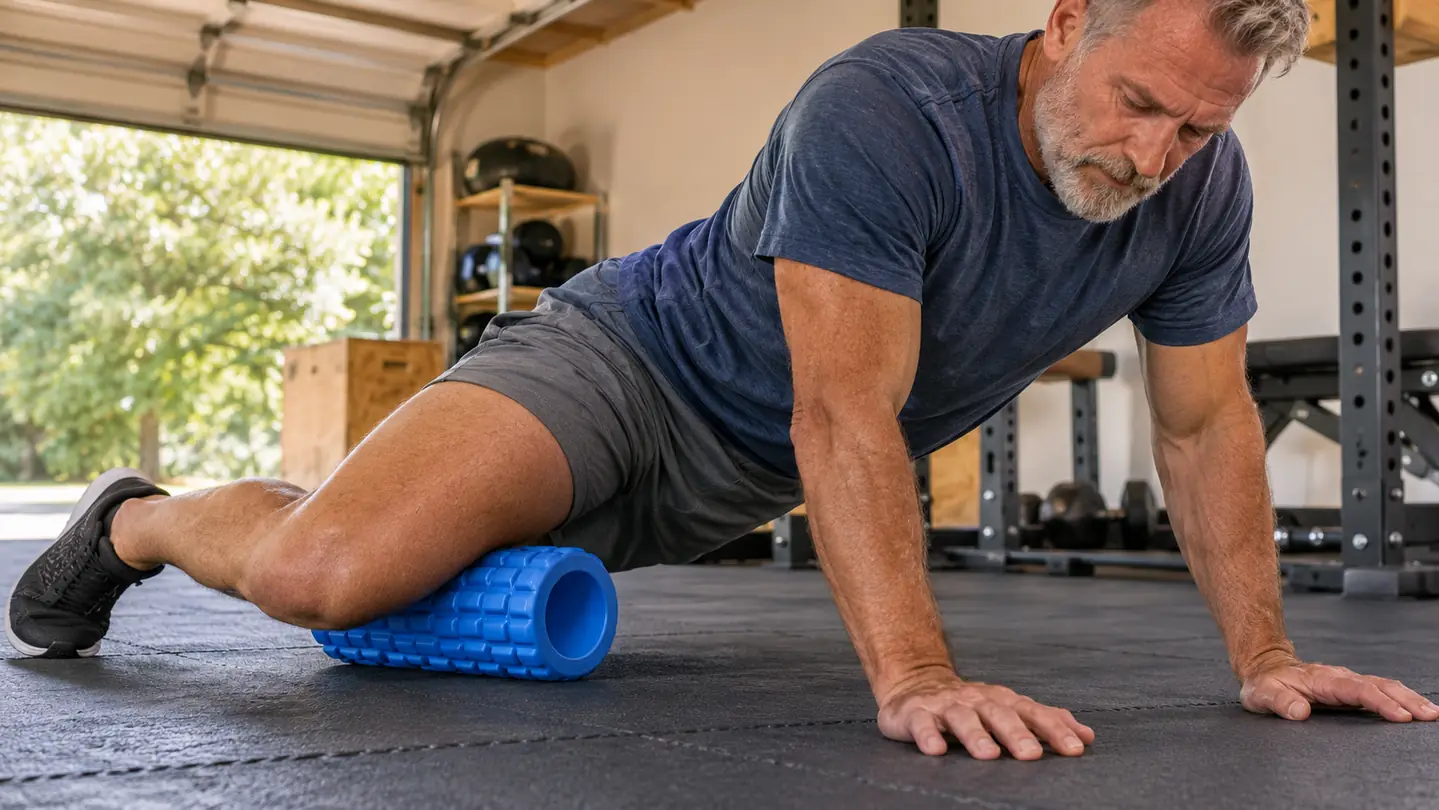
My gym is a converted one-car garage bay in Tulsa with rubber floor tiles, a box fan, a whiteboard and one wall mirror. There is no trainer on staff and nobody to tell me I am doing it wrong, which means a piece of equipment has to be usable by a 52-year-old woman in shorts at 6:20 in the morning without a learning curve that eats the whole session. I rolled three or four mornings a week before my Saturday group arrived, plus Tuesday and Thursday evenings with Ray. That is somewhere north of sixty sessions, which is enough to have an opinion that is not based on one enthusiastic afternoon.
To keep this from turning into a vibe, I wrote the date on the whiteboard every morning I rolled and put a mark next to whatever had loosened up. The first week the marks were all calves. The second week the quads showed up. By the fourth week I had stopped bothering with the board, not because I got bored but because the routine had become as automatic as putting on shoes. I also tried rolling with the fan off exactly once, in July, in a garage in Oklahoma, and I do not recommend that particular experiment to anybody. Ten minutes in I was sweatier than the workout that followed.
The sequence I settled into is the one I would hand to anybody. Calves first, because they complain the least and they warm you up to the pressure. Then quads, one leg at a time, slow. Then the outer hip and the glute, which is where the GRID earns its keep and where my old smooth roller was basically a nap. Then upper back, lying perpendicular to the roller with my arms crossed over my chest. Right shoulder last and carefully, because that shoulder has a history and I do not argue with it before coffee.
Ray uses it on his left quad and around the outside of his knee, never directly on the joint, because that is what his physical therapist told him and we follow instructions in this house. He is not a foam roller enthusiast. His review, nearly verbatim, was that it hurts in a useful way, which from Ray counts as a rave. He also likes that it is small enough to leave on the floor beside the shelf instead of hauling it out of a closet every time.
What Nobody Tells You About the First Two Weeks
The first pass on my right quad did not feel like recovery. It felt like being told, in detail, about every hill I have walked up in the past year. The ridges find things. Week one, I was rolling maybe ninety seconds per leg and calling it done, and even that left my legs feeling talked about for the rest of the morning. If you have read a review that described this roller as soothing, that person either has a very high tolerance or a very short memory.
There is a temptation, when a tool is extra firm, to press harder to prove you can take it. Do not. The GRID works fine under your own body weight with no extra push at all. The people who get sore in a bad way on a roller are almost always the people who decided to lean in and show it who is boss. If you are holding your breath, you are pressing too hard. If your face is doing something you would not want photographed, same answer. That is the entire technique, and it is the thing I most wish someone had said to me in week one.
The GRID does not reward enthusiasm. It rewards slow, boring, bodyweight pressure, and it tells you immediately when you have stopped being patient.
Somewhere in the middle of that first week I made the classic mistake of rolling my lower back because it felt tight. It did not help, and the next morning it felt the same or slightly worse. Rolling the glutes and the outer hip instead is what actually loosened things up, which is the sort of thing a trainer says out loud and nobody believes until they try it themselves on a Tuesday. The GRID is too firm for direct lower back work anyway, which is a handy excuse to do the thing that actually works.
The second week is where it turns. Pressure that felt like a complaint on Monday feels like a tool by Friday, and by the end of week two I was rolling before the Saturday group instead of after, which is the opposite of what I did for years. My shoulder came back overhead in the cool-down without the usual argument. I am not going to sit here and tell you a foam roller fixed my shoulder. I will tell you that it made my warm-up long enough and specific enough that my shoulder stopped being the reason I cut the cool-down short, and that is worth something.
The Extra Firm Feel Is the Whole Story
Everything good and everything annoying about this roller comes from one decision: it is extra firm. Firm means the foam does not squash flat under you, so the pressure stays where you put it instead of spreading out into a vague sense of having tried. On a soft roller, your body weight sinks in and the pressure goes nowhere. On the GRID, you decide how much you want, and the answer stays the answer for the whole pass instead of fading out halfway through.
The varying ridges and nodules matter more than I expected. Across the middle of my back, where I want broad pressure, the wider surface spreads the load and I can stay there for a minute without flinching. On the outside of my hip, where I want something more pointed, the ridges give me that without me having to hunt around for the right spot. One tool, different pressures, depending on which part of the surface you land on. That is a real difference from a smooth tube, and it is the reason I have not gone back.
It is also small, and I did not expect to care about that as much as I do. Thirteen inches fits across my back without hanging off both sides, it stands in the corner by the shelf, and it fits in the footwell of the car. That last part matters more than it should, because I have carried it to a neighbor's driveway twice when the garage was too hot to be in. It weighs about a pound, so nobody is going to strain anything carrying it, and there is nothing to assemble, charge, or lose.
This is the part I would tell a friend standing in my garage holding it. The TRIGGERPOINT GRID does one job and does it without electricity, calibration or an instruction booklet, and that is exactly why it survived a full season in my gym while two other gadgets went into the donation box. There is nothing to update and nothing to break. You either want pressure or you do not, and the roller is not going to talk you into it. For a garage where the floor is already crowded, that simplicity is most of the value.

Where It Falls Short
Firmness is not free. If you have never rolled before, this is not where I would start, and I say that as someone who now likes it. The honest recommendation for a total beginner is a softer, smoother roller for a month, then this one. The TRIGGERPOINT GRID does not have a gentle setting, and it does not care that it is your first Tuesday.
The ridges are too much in a couple of places. Along the shin and directly over the IT band, the nodules are more than I want, and I end up working those areas with a hand ball instead. If you are the kind of person who winces at a deep tissue massage and asks them to go lighter, this is the same sensation with nobody standing there asking if the pressure is okay. Some bodies love that. Some bodies will leave it in the corner after three sessions.
And it is foam, so treat it like foam. Mine lives in a garage where summer gets past a hundred degrees, and I bring it inside when we are going to be gone for a week. It has held its shape well through a season of steady use, but nobody should expect a foam tool to last forever. It is also worth saying out loud that fifteen minutes on this thing is plenty. There is no prize for staying on longer, and I have absolutely given myself a sore spot on a Sunday and paid for it on a Monday. More is not better. Better is better.
I also notice the firmness more on cold mornings than on warm ones. In January I march in place for five minutes before I get down on the floor, not after, because the GRID is honest about what forty degrees does to a hamstring and I would rather be warm than proved right. That is not a flaw in the roller. It is a flaw in how most of us use one, including me for the first several weeks.
What I Liked
- Extra firm foam holds its shape and keeps pressure where you put it instead of spreading out
- Multi-density ridges and nodules give different pressure across different parts of the body
- Thirteen inches fits across the back and stores in a corner or a car footwell
- About 1.1 pounds, so it travels to a neighbor's driveway without a second thought
- Useful before a workout as part of a warm-up, not only after one
Where It Falls Short
- Genuinely too firm for someone who has never rolled before
- Ridges are too aggressive on the shin and directly over the IT band
- The small surface means a taller or broader user may want more length
- It is still a foam roller, and it will not replace hands-on work for a real problem
Who This Is For
This is for the person who has already rolled a few times and wants more pressure than soft foam gives. If you are in your thirties to sixties, training at home in a spare room or a garage, and you have two or three stubborn spots that a soft roller skates right over, the GRID is a sensible upgrade. It suits people who like a firm massage, who are comfortable working at their own pace, and who do not need to be talked through every minute of it.
It also suits anyone short on space. A 13 inch roller fits in a corner, under a shelf, or in a gym bag, and it needs no outlet and no setup. My Saturday group passes it around between sets and nobody has needed instructions beyond where to put their leg and how slow to go. That is about as good a sign as a piece of equipment can give, honestly, because nobody in that group is polite about things they do not like. If six neighbors with six different bodies keep picking it up without being asked, the TRIGGERPOINT GRID is doing something right.
Who Should Skip It
Skip it if you are brand new to rolling and the word firm makes you nervous. Start softer. You can always buy this later, and you will get far more out of it once your legs have stopped being surprised by contact. Skip it too if you have an active injury and no professional guidance, because no roller on earth is a substitute for somebody actually looking at your knee and telling you what to do with it.
Skip it if you want a long roller for lying across the full length of your back or for working both legs at once. Thirteen inches is a personal-size roller, and a taller or broader body is going to want more real estate than that. And skip it if what you really want is something to lie on and relax into at the end of the day. This is a tool, not a cushion, and it will remind you of the difference on the very first pass.
If Firm Is What You Actually Want, This Is the One I Keep Reaching For
Extra firm foam, a multi-density surface, about 1.1 pounds, and small enough to live in the corner of a garage. Check today's price on the listing and read the dimensions before you order.
Amazon Check Today's Price on Amazon →