
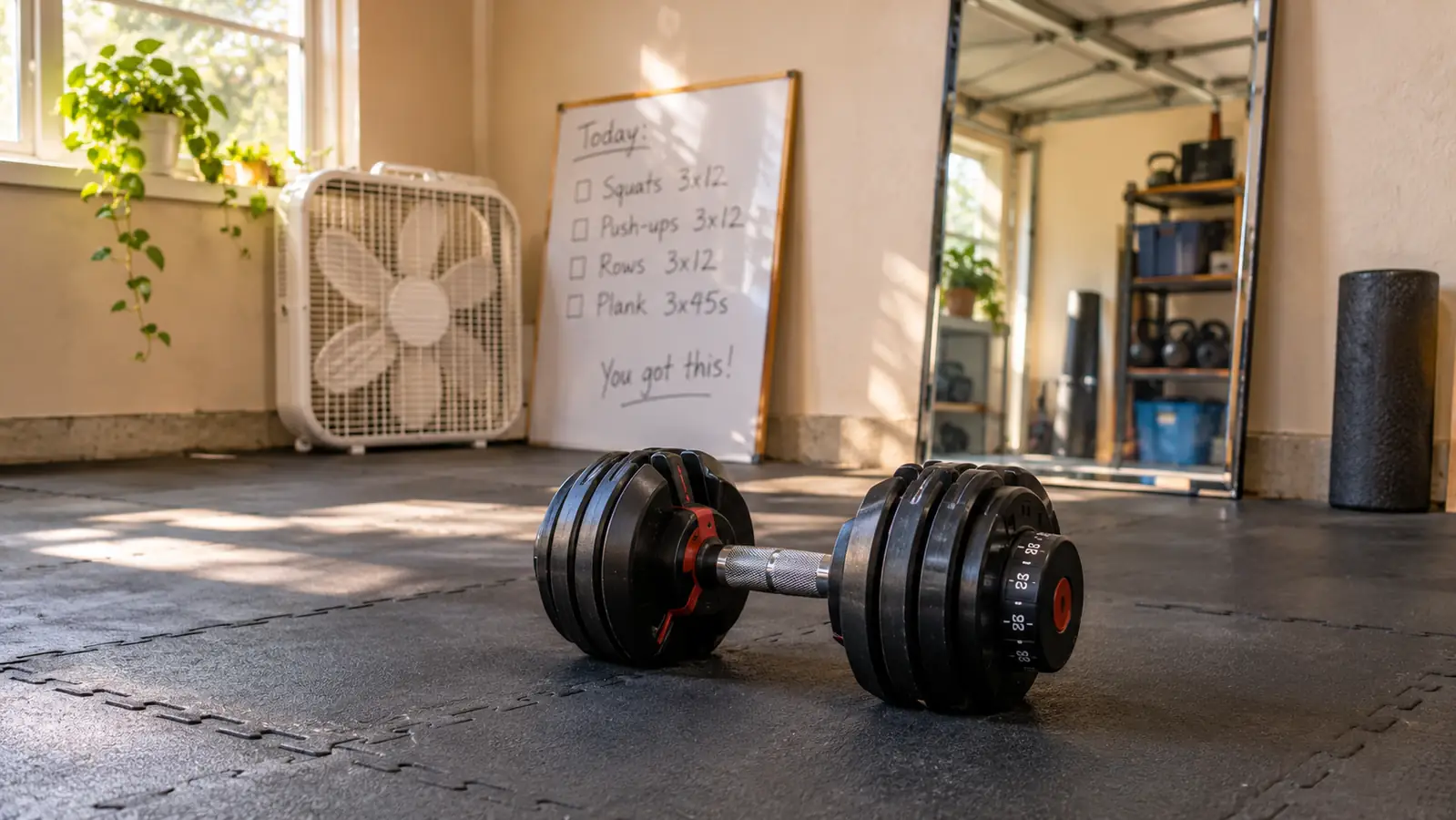
For a while, the back corner of my garage held a small monument to good intentions: a shelf of hex dumbbells I mostly walked past. Fifteens, twenties, one lonely thirty-five that Ray used twice and then never touched again. They ate a shelf I could have used for towels, and every Saturday my group had to queue for a single pair while somebody counted reps out loud. In March I cleared the whole shelf and put one set in its place: the Lifepro Adjustable Dumbbells. I have used them three mornings a week since, plus a short Thursday session, and Ray has used them twice a week for the knee-friendly work his physical therapist handed him. This is what months of that actually looked like, including the parts I do not love.
The short version: the quick-adjust dial works as smoothly in month five as it did in week one, the range covers most of what a person training at home actually needs, and the ceiling is real. Twenty-five pounds is plenty for a lot of shoulder, arm and core work and not nearly enough for a seasoned lifter's heavy pressing. The question was never whether these are the finest adjustable dumbbells ever made. It is whether they fit the way you train, in the room you actually have.
The Quick Verdict
A genuinely useful 5 to 25 pound set that replaces a shelf of fixed dumbbells and works beautifully for joint-friendly, general-strength training. It runs out of weight fast if you already lift heavy.
Amazon Check Today's Price →One dial, one cleared shelf, and no more queue at the dumbbell rack
The dial moves from 5 to 25 pounds in 2.5-pound steps, with a locking mechanism that has held through five months of my Saturday group. Check the current listing for the set configuration that fits your room.
Amazon Check Today's Price on Amazon →How I've Used It
My gym is a converted one-car garage bay. Rubber tiles on the floor, a box fan in the corner, a whiteboard on the wall, one mirror I hung slightly crooked and never fixed. There is no room for a rack and no room for a wall of hex dumbbells, which is the whole reason I went looking at the Lifepro set in the first place. Monday is full body. Wednesday is upper body with a long, careful warmup for my right shoulder, the one I hurt years ago and still baby. Saturday morning is the group. Thursday is fifteen minutes of light arm and shoulder work while dinner is in the oven.
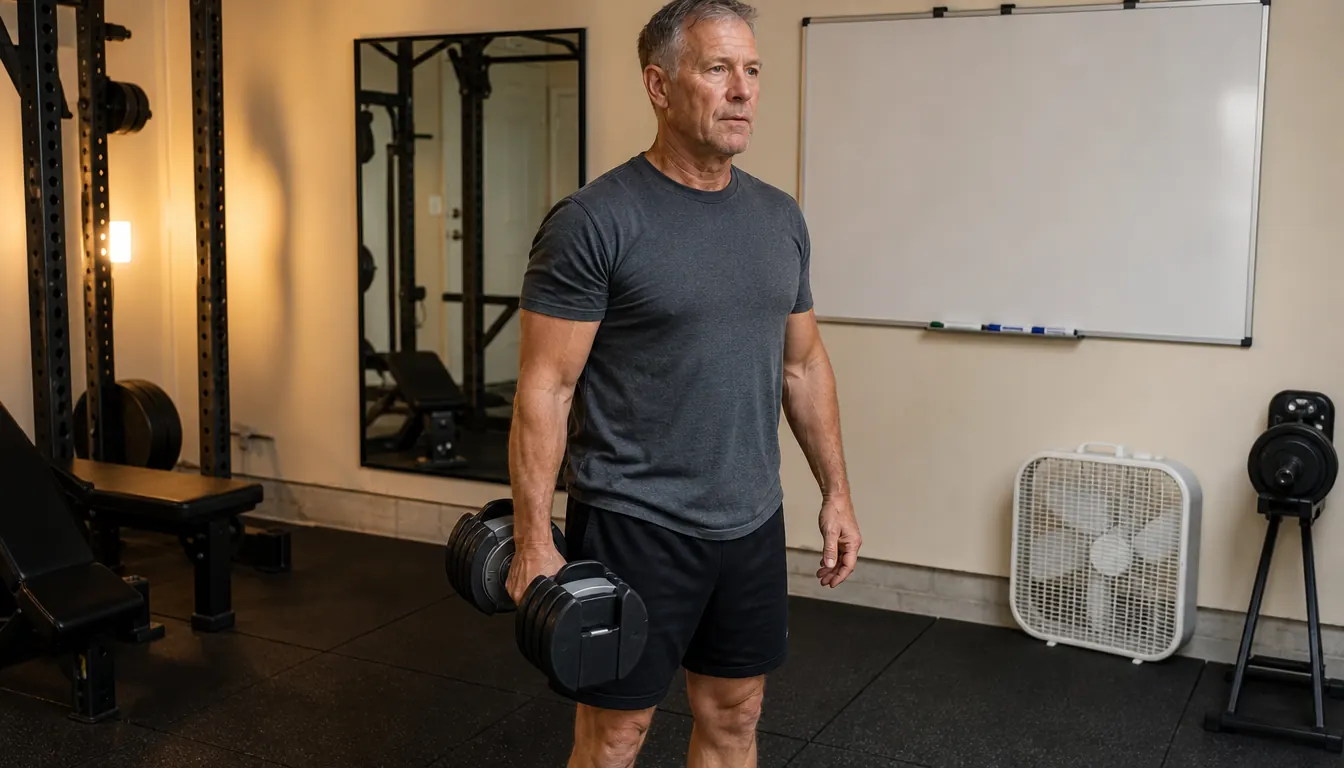
Ray is fifty-eight and has a left knee that complains on stairs. He works out with me twice a week and does seated pressing, supported rows, and slow step-ups onto a low box. What he needs from a dumbbell is a weight light enough to set down without drama and pick back up without twisting anything. What my Saturday group needs is six people changing weight in the middle of a superset without stopping the room. Those are two different demands, and the same set has handled both for five months.
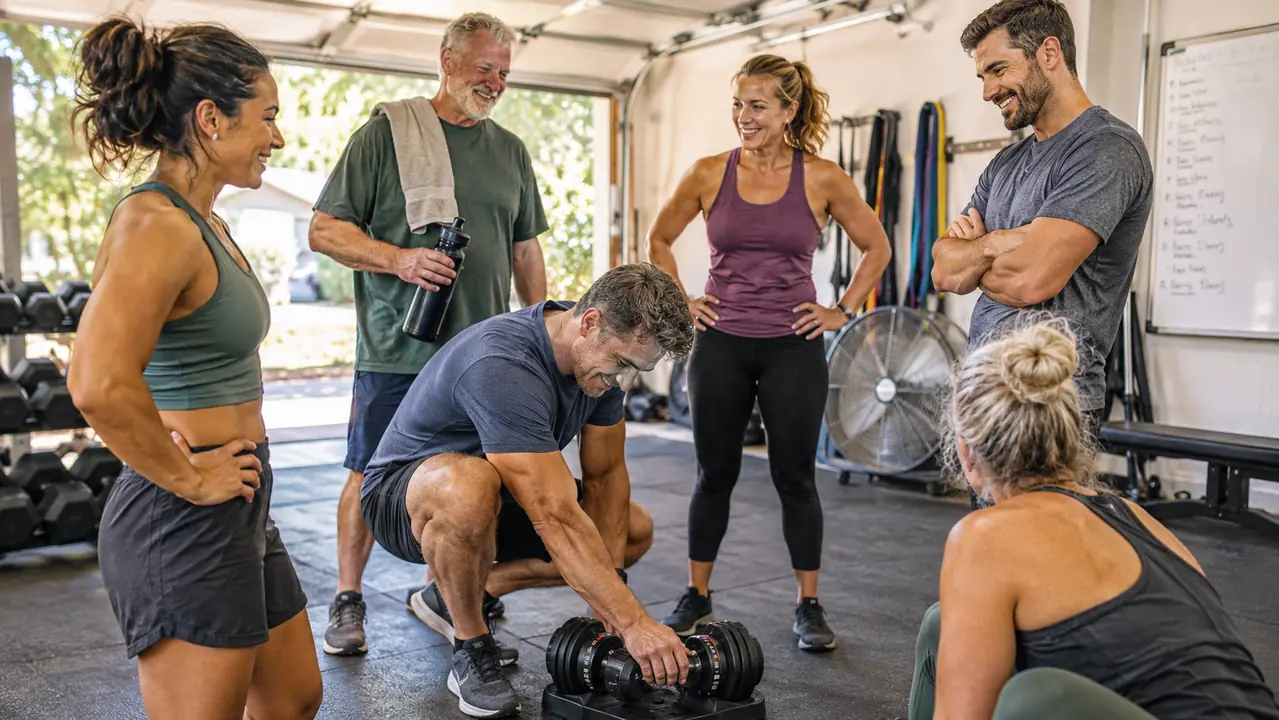
The group is about six neighbors, most of them between forty and sixty-five, most of them starting over after a long break. In the old days a set change meant a five-minute rummage on the shelf. Now it means one turn of a dial. That sounds like a small thing until you are the one holding the stopwatch. In a forty-five minute session where we change weight four or five times, it is the difference between a workout and a line at the post office.
The Quick-Adjust Dial, Months In
The mechanism is what the listing says it is: a single dial that moves the set between 5 and 25 pounds in 2.5-pound increments, plus a locking mechanism that holds the weight you selected. You turn the dial to the number you want and lift. No pin to pull and re-seat, no plate to slide on by hand while you are breathing hard and counting. The first week I kept checking the lock out of habit, the way you check a hotel door after you close it. By week three I had stopped thinking about it, which is the highest compliment I can pay a piece of equipment.
The 2.5-pound steps matter more than they sound like they would. If you have ever gone from a ten to a fifteen on a lateral raise and felt your form fall apart on rep three, you know exactly why. Two and a half pounds is big enough to count as real progress and small enough that my right shoulder does not file a complaint. Over four months I moved that shoulder from 5 to 7.5 to 10. That is not a dramatic number and I am not going to dress it up as one. It is also the first time in years that shoulder has progressed at all.
The dial itself has stayed crisp. Five months of three-times-a-week use, plus six other people turning the same dials every Saturday morning, and nothing has gone soft or sticky or vague. On a couple of older adjustable sets I have tried, the dial starts to feel like a radio tuner that will not quite land on the station. These still land, every time. If that changes, I will come back and say so.
What 5 to 25 Pounds Actually Covers
More than you would guess, if you are training for general fitness rather than for a powerlifting meet. Five to twenty-five pounds covers lateral raises, front raises, rear delt work, biceps curls, hammer curls, overhead triceps extensions, kickbacks, and every shoulder rehab exercise anyone has ever handed me on a printed sheet. It covers a lot of the rowing and pressing my group does, especially for the people who are three weeks back into exercise. It covers lunges and step-ups for most of the room, and it covers the light, high-rep work that makes up a big chunk of a Saturday class.
Where it runs out is straightforward. Twenty-five pounds is a warmup weight for a man who has been bench pressing for twenty years. Ray can press these overhead for high reps and get a good session out of it. A thirty-five year old who wants to build a chest is going to run out of weight in about six weeks. That is not a flaw in the product so much as a description of what it is: a compact set for general strength and joint-friendly work, not a stand-in for a full rack of heavy iron. If you are choosing between this set and a dial-based competitor, there is a full Lifepro vs BowFlex SelectTech comparison on this site. And if you are still deciding whether adjustable dumbbells make sense for you at all, 10 reasons adjustable dumbbells suit home workouts covers that ground properly.
Build Quality, Grip, and the Lock
The construction is alloy steel, and the set is listed at 25 pounds with a footprint of 13.6 inches long by 6.7 inches wide. What that means in a real garage is that it lives on the floor next to the whiteboard without anybody tripping over it, and it feels like a real dumbbell in the hand rather than a plastic stand-in. After five months of being set down on rubber tiles, sometimes with more care than others, nothing has rattled. Nothing has loosened. Nothing has developed the hollow clunk that tells you a mechanism is giving up on you.
The grip is textured and non-slip, and it has held up better than my hands have. I have a garage in Oklahoma and a box fan that does its level best in July, and sweat on a smooth handle is a genuine problem. The texture here is enough to stop the dumbbell rotating in a wet palm without being so aggressive that it shreds your calluses. Ray, who has the driest hands of any human I have ever met, has not complained once. For Ray, that is a headline.
Five months in, six people turning the same dials every Saturday, and nothing rattles when I set the weight down between sets.
Living With Them in a One-Car Garage
The space question is the one that got me started, so it deserves a straight answer. My old shelf of hex dumbbells took up roughly the footprint of a small bookcase and gave me five fixed weights. The Lifepro set takes up less floor than a pair of running shoes and gives me nine settings between 5 and 25 pounds. I got a shelf back. I got a corner back. The whiteboard is legible again because nothing is stacked in front of it. If you are working out in a spare bedroom or a narrow garage bay, that difference is the entire argument.
Moving them around is easy because they are compact, not because they are light. Twenty-five pounds is twenty-five pounds, and if you carry two across the garage at once you will feel it in your forearms. I carry one at a time, which also means I do not drop one on my foot. For the Saturday group, the set sits in the middle of the circle and people pick up what they need when they need it. That is a small logistical thing that has made the class run about ten minutes shorter.
Where They Fall Short
Three honest complaints. First, the ceiling. Twenty-five pounds is the top of the range and there is no expansion path, so if you get stronger you eventually buy something else, and the something else is usually bigger and more expensive. Second, two dumbbells means two dials, so a paired exercise takes two adjustments instead of one. It is fifteen seconds. It is also fifteen seconds I notice when I am trying to keep six people moving. Third, these are not dumbbells you drop. They are steel with a mechanism inside, and a mechanism that gets dropped on rubber is a mechanism that eventually stops locking when you need it to.
And the honest fourth thing, which is not really a complaint: adjustable dumbbells are always a compromise. A fixed dumbbell is simpler and you never wonder whether the lock is set. You trade that simplicity for floor space and for a whole range of weights inside one object. Whether the trade is worth it depends entirely on the size of your room, and my room is small, so I made the trade and I would make it again.
What I Liked
- Replaces a shelf of fixed dumbbells with something that fits beside a whiteboard
- Dial moves from 5 to 25 pounds in 2.5-pound steps, small enough for careful shoulder work
- Locking mechanism has stayed firm through five months and six people turning it
- Textured non-slip grip holds in a hot garage without shredding calluses
- Alloy steel build feels like real equipment, not a plastic stand-in
Where It Falls Short
- 25 pounds is the hard ceiling and there is no way to add on
- Two dumbbells means two dials between paired sets
- Not built to be dropped at the end of a set
- Runs out of weight quickly for anyone already training heavy
Who This Is For
This set fits the person I coach most often: someone between thirty-five and sixty-five, training in a spare room or a garage, coming back to strength work after a stretch away, and not interested in building a shrine to fitness. It fits anyone whose shoulder, knee or back needs small jumps between weights rather than big ones. It fits a household where two people of very different strength levels share one set, which is exactly what Ray and I do. And it fits anyone whose gym has to fold away, because this one folds away simply by being small.
Who Should Skip It
Skip it if you already press, row or squat heavy and want to keep progressing, because you will pass 25 pounds in a matter of weeks and then you are shopping again. Skip it if you and a partner train side by side at very different weights at the same time, because one set cannot be in two places at once. Skip it if you want the dead simplicity of a fixed dumbbell and you have the floor space for a rack. And skip it if you are the sort of person who drops weights at the end of a set, because this is not that kind of equipment and it will not forgive you for long.
If a shelf of hex dumbbells is what has been stopping you, this clears the shelf
5 to 25 pounds on one dial, 2.5-pound steps, alloy steel construction, and a lock that has held through five months and six neighbors. Check the current listing for the set configuration that suits your room.
Amazon Check Today's Price on Amazon →