
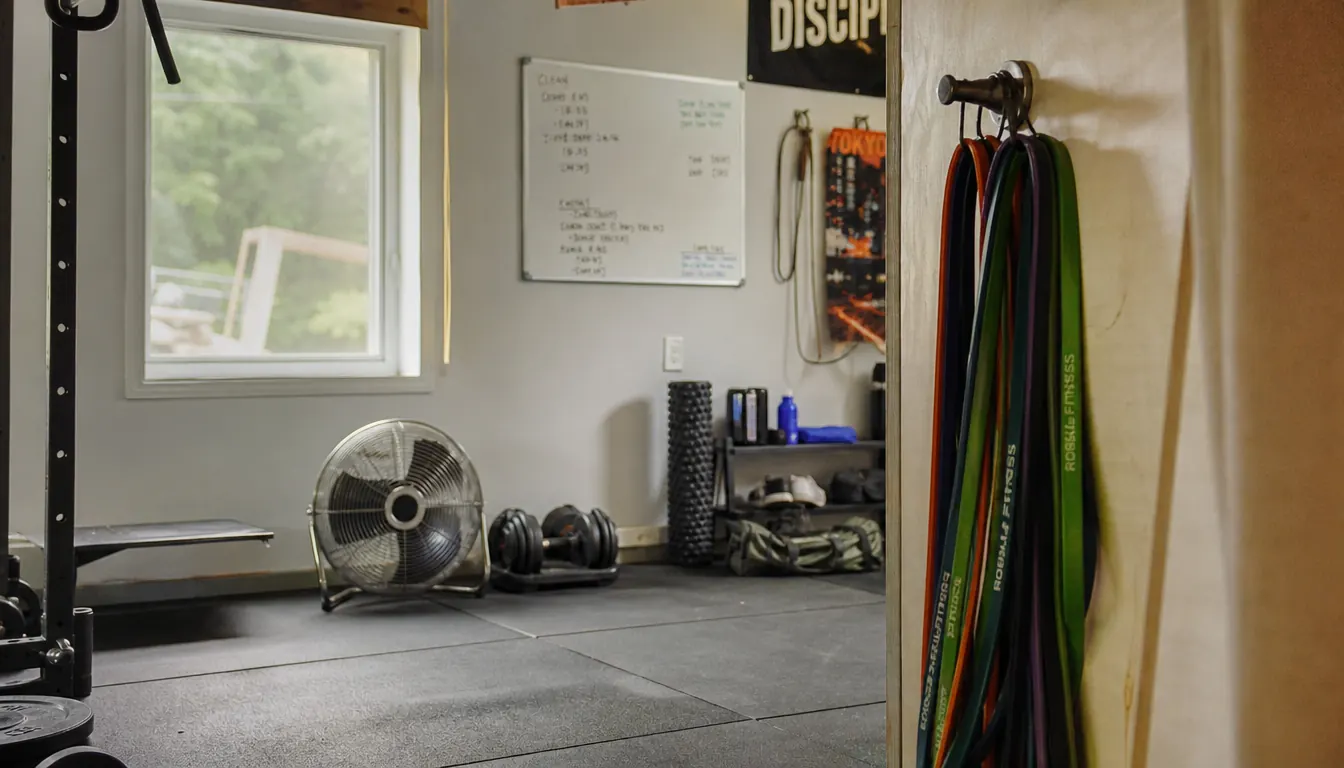
Most home gyms fail for a boring reason. Not laziness, and not motivation. The equipment asks too much of the body on the day you finally have twenty minutes to use it. A barbell wants a spotter and a full night of sleep. A set of dumbbells wants a shoulder that does not complain. So the bench collects laundry, the plates stay stacked in the corner, and the strongest person in the house is the one who keeps meaning to start again on Monday.
I have watched that happen in my own garage in Tulsa, and I have watched it happen to half the neighbors who show up to my Saturday group. What broke the pattern for us was not a bigger purchase. It was a small one: the Fit Simplify resistance loop bands, five latex loops that hang on a hook by the door and take up less shelf space than a pair of shoes. I keep one set in the garage and a second set in the carry bag for the park. They are the reason Ray can get a leg session in on a night his left knee is cranky, and the reason I can train my right shoulder on days when pressing anything overhead is a bad idea.
Five loops on a hook by the door beat a rack you walk past
The Fit Simplify set gives you five resistance levels, a carry bag and an illustrated guide with dozens of exercises, so you can start lighter than you think you need and add tension in small steps. No spotter required.
Amazon Check Today's Price on Amazon →Why Bands Build Strength at All
Bands do not get the respect that plates get, and I think that is mostly a branding problem. When you stretch a loop band, the tension climbs as the band lengthens. So the hardest part of the movement lands at the end of your range rather than the middle. For a lot of adults that is exactly where the work is needed and exactly where a dumbbell gets easy and lets you coast through the finish.
The second reason is that bands let you train hard without loading your spine. Ray is fifty eight and his left knee has opinions. He is not going to back squat, and he does not need to. He can do a banded sit to stand, a banded press against the wall, and a banded hip hinge, and he gets the same muscles working with a fraction of the downside. That trade matters more than any chart I could draw.
The third reason is smaller and maybe the most important. A band fits in a drawer. When a workout is easier to start than to skip, you do it on a Tuesday instead of waiting for a perfect Saturday. Showing up is a logistics problem before it is a willpower problem, and bands solve the logistics.
Step 1: Start With the Band You Can Finish the Set With
The set comes with five levels, and the extra light and light bands are not a warm up for the real work. They are the real work for a beginner, and often for a returner too. The mistake I see most often is a man in his forties grabbing the heaviest loop in the bag because a lighter one feels like nothing for the first three reps. By rep eight he has lost the position and is swinging his whole torso to finish.
Here is the test I hand out on Saturday mornings. Pick a band, do eight reps of a row, and try to hold the last rep for a two count at the end. If you cannot, the band is too heavy. Not too heavy for your ego. Too heavy for the joint you are asking to do the work. Drop down a level and finish twelve clean reps instead.
There is no prize for the heavy band and no penalty for the light one. You want a band where the last two reps of a set of twelve are genuinely hard and the first two feel almost easy. That is the entire selection process, and it takes about ninety seconds once you know what you are looking for.
Step 2: Anchor the Band So It Cannot Slip
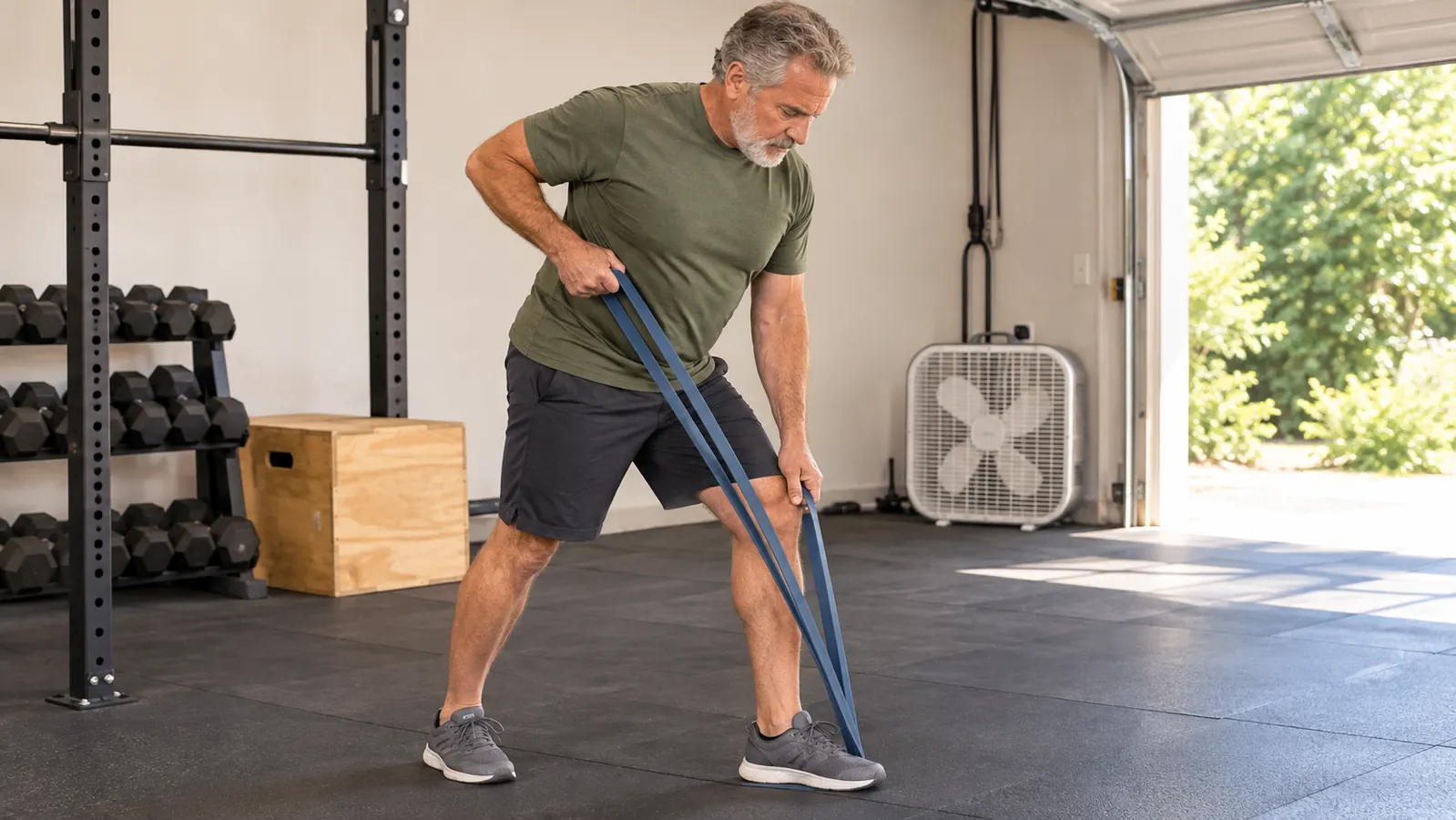
A band that slips is worse than no band at all, because it teaches you to move cautiously in a way that wrecks the exercise. Before you pull on anything, decide what is holding the other end. A closed door with the hinge on your side, a sturdy post, the leg of a loaded treadmill, or your own foot when the movement calls for it.
For a door setup, run the band around the hinge side and close the door fully so the latch catches. Never use the handle side of a door, and never use a door that opens toward you. I have seen a band come back across a garage fast enough to leave a mark on a forearm, and the person attached to that forearm was lucky it was not an eye.
When the band goes under your foot, stand on the middle of the loop rather than the edge, and keep the foot flat. When it sits around your thighs for a lateral walk, check that it rests above the knee and below the hip crease where it will not roll. Two minutes of setup buys you a whole session of not thinking about the band.
Step 3: Slow the Return Down
This is the one change that turned bands from a warm up toy into real strength work for me. Most people pull hard and then let the band snap them back to the start. The return is where half the benefit lives, and it costs nothing. You already own the reps. You are only deciding how long each one takes.
Use a three count on the way back. Pull for one, hold for a beat at the end, and take three seconds to return under control. If the band is snapping back faster than you can count, either the band is too heavy or you are tired. Both answers are useful information, and neither is a reason to feel bad.
Ten slow reps beat twenty fast ones for the same reason a deliberate walk beats a shuffle. The muscle stays under tension longer, the joint gets a smoother ride, and you finish feeling worked instead of rattled. My Saturday group groans about the count, then they do it, then they notice in about three weeks that the light band feels like a different object.
Step 4: Add Range of Motion Before You Add Resistance
When a movement starts to feel easy, the urge is to grab the next band up. Resist that for two weeks. Instead, take the same band further. A row that stops at your ribs can finish at your hip. A squat that stops halfway can sink another few inches. A press that stops at shoulder height can reach overhead if your shoulder allows it.
Range is where strength becomes useful in real life. Getting off the floor, carrying groceries up the steps, lowering yourself onto a low couch without using your hands, all of those are end range jobs. Training the last few inches is the difference between gym strong and life strong.
Keep the same rule as before. If you lose your posture at the new range, you have gone too far for today. Back off two inches, own that, and come back to the full range next week. A body that is asked politely will give you more than a body that gets yanked.
Step 5: Write It Down and Move Up One Band at a Time
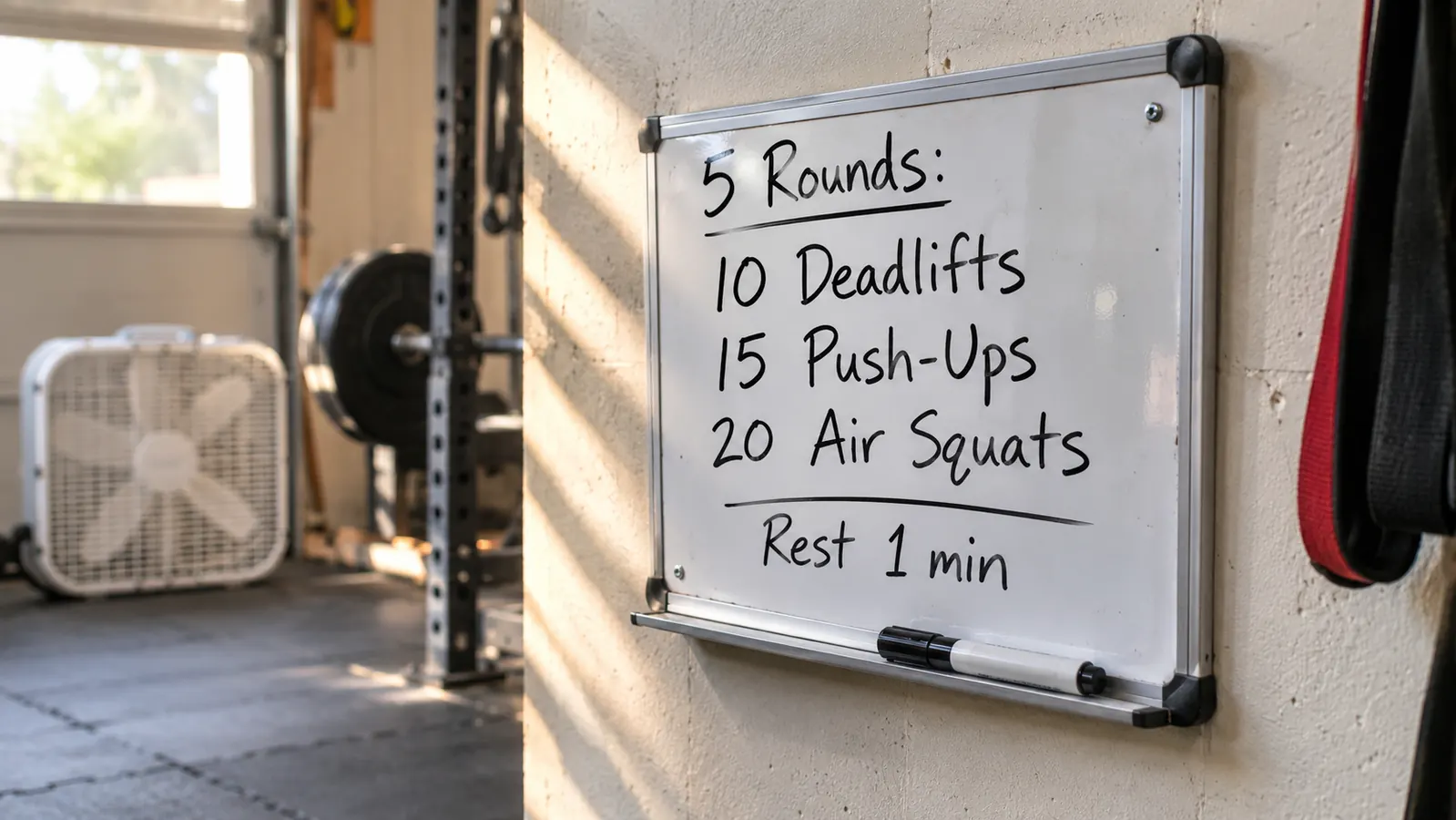
I keep a whiteboard on the garage wall for one reason. Memory lies about training. You will swear you did three sets of fifteen last week when you really did two sets of ten. Writing it down turns progression into a decision instead of a feeling.
The rule on my whiteboard is simple. When you can do three sets of twelve slow, full range reps with a band, on two separate sessions, you have earned the next level. Not before. Two separate sessions matters, because one good day is weather and two good days is a trend.
This is slower than the internet would have you believe, and it works better. Small jumps protect the joints that got you into this in the first place, and they give you a run of wins instead of one heroic session followed by a week on the couch. Ray moved from the extra light band to the light band over about six weeks. That is not a headline. It is a knee that complained less on the stairs, which is the only headline he cared about.
What Else Helps
Bands reward a few habits that have nothing to do with the bands. The first is a warm up that actually moves the joints you are about to load. Five minutes of arm circles, hip circles and slow bodyweight squats does more for a fifty two year old shoulder than twenty minutes of stretching afterward.
The second is pairing. Choose one pull, one push, one squat pattern and one hinge pattern, then run them as a circuit with a minute between rounds. You do not need forty exercises. You need four done well, twice a week, for three months. The illustrated guide in the Fit Simplify bag lists dozens of options if you want variety, and dozens is plenty to keep four movements interesting.
The third is a floor rule. If a movement hurts in a sharp, local, catching way, stop and change the setup. Bands make it easy to keep pushing through discomfort because there is no plate to set down, so you have to be the one who calls it. Dull effort is fine. Sharp pain is a message. My right shoulder taught me that years ago, and I warm it up carefully every single session now.
The fourth is portability. The whole set plus the carry bag slides into a backpack, so a vacation or a week at a relative's house does not become a hole in your training. I have done a full session in a hotel room with a door anchor and one loop, and I have done one in a parking lot before a long drive. Momentum is much easier to keep than to rebuild.
Ray moved from the extra light band to the light band in about six weeks. It is not a headline. It is a knee that complained less on the stairs.
If you are waiting for the day you have room for a rack, or the day your knee is perfect, or the day you feel like training, I will save you the wait. None of those days is on the calendar. The bag of loops on the hook is here now, and it will meet you wherever your body is this morning.
Start with the light one and let the reps do the talking
Five latex loops, five resistance levels, a carry bag and an illustrated guide with dozens of exercises. No rack, no spotter, no membership. Start lighter than you think you need and take the next step when the whiteboard says you earned it.
Amazon Check Today's Price on Amazon →