
My knees gave the answer before my brain did. I had been using a thin foam mat on the rubber tiles in my garage, and every time I came out of a low lunge my right kneecap filed a small complaint. So I ordered the Gaiam Essentials mat, the 1/4-inch version, mostly because several people in my Saturday group already owned one and none of them had anything bad to say about it. That was the entire recommendation, honestly. No spreadsheet, no research. Months later, after using it three or four mornings a week plus a couple of driveway sessions, I have a more useful opinion than the one I started with.
Here is the short version. The Gaiam Essentials is 72 inches long, 24 inches wide and 6mm thick, made of nitrile butadiene rubber, and it weighs about 3 pounds. It is not the softest mat you can buy and it is not the lightest. What it is, is a mat that stays put under your hands, gives your knees and wrists real padding on hardwood, tile or carpet, and has not started shedding crumbs onto my floor after months of being stepped on, rolled up slightly damp once by accident, and stored standing in the corner of the garage.
The Quick Verdict
A dependable, genuinely grippy 6mm mat for floor work at home. Buy it for the padding and the traction, not for portability, and not if you need deep cushioning.
Amazon Check Today's Price →A mat that keeps your knees out of the conversation
The Gaiam Essentials puts 6mm of padding between you and a hard floor, with a textured surface that holds your hands where you put them. If your current mat slides or your knees complain on tile, this is the swap worth making.
Amazon Check Today's Price on Amazon →How I've Used It
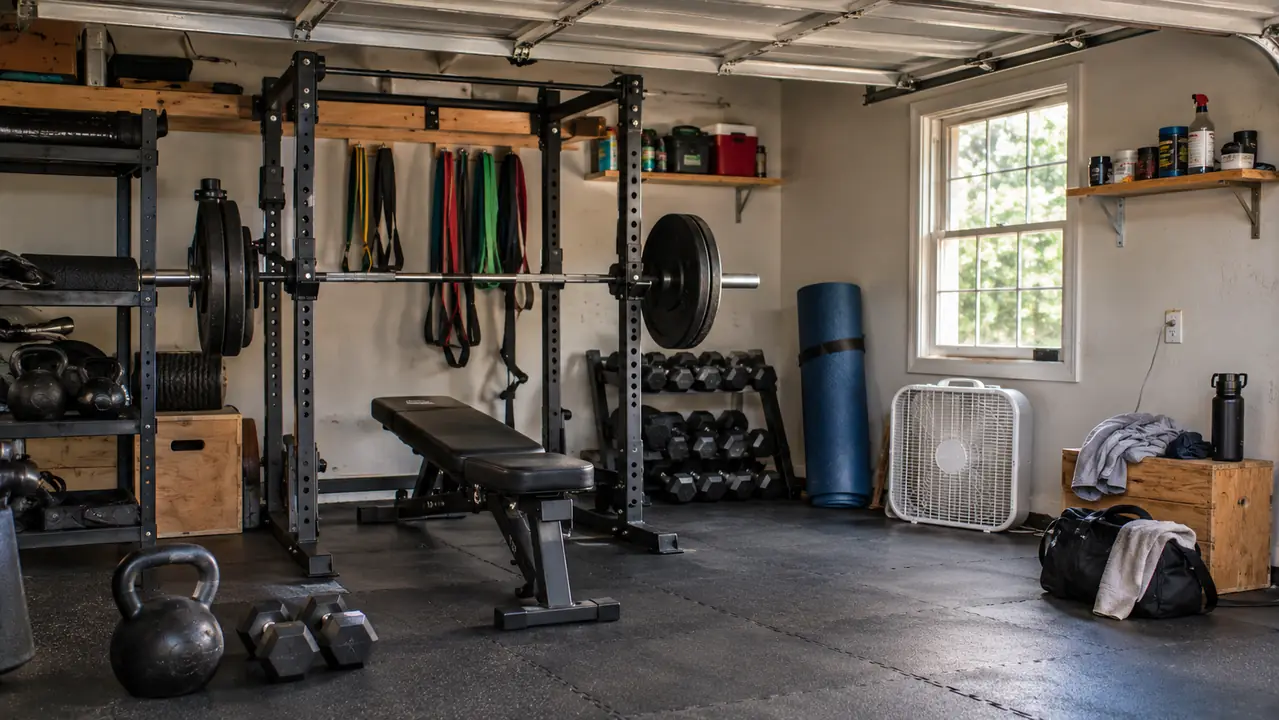
My gym is a converted one-car garage bay. Rubber floor tiles, a box fan, a whiteboard, one wall mirror, and a door that sticks in the summer. The floor under those tiles is concrete, so it is not a forgiving surface. I coach about six neighbors on Saturday mornings and I do my own low-impact work three or four other mornings, and the mat is under me for all of it. Warm-ups, planks, glute bridges, supine work, the slow balance drills I run through while my right shoulder wakes up.
That shoulder is why I warm up the way I do and why I spend more time on the floor than most people bother with. I hurt it years ago and the positions that still bother it are the ones where I am propped up on my forearms. A mat that lets my elbows sink and then slide sideways is worse than no mat at all. This one does not do that. It holds, which sounds like a small thing until you have spent a winter sliding around on a bargain mat.
I measured the mat against the wall mirror the first week, mostly out of curiosity. Seventy-two inches is taller than the mirror is wide, and when I lay it out lengthwise in front of the whiteboard it covers most of the span between the fan and the door. That sounds trivial, but it matters when you are planning a room. I can run a full set of floor work and a standing warm-up on the same mat without stepping off either end. The old foam mat was shorter and I spent half of every session dragging it back into place.
My husband Ray trains with me twice a week. He is 58, his left knee has opinions, and he is the real test case in this house, because he is heavier than I am and he does not baby a joint just because it is complaining. He uses the mat for the standing and floor portions of the Saturday session and he has stopped making the face he used to make during lunges. That is about as technical as I can get about it, and I think it is the honest version.
The 6mm Thickness: What It Actually Feels Like
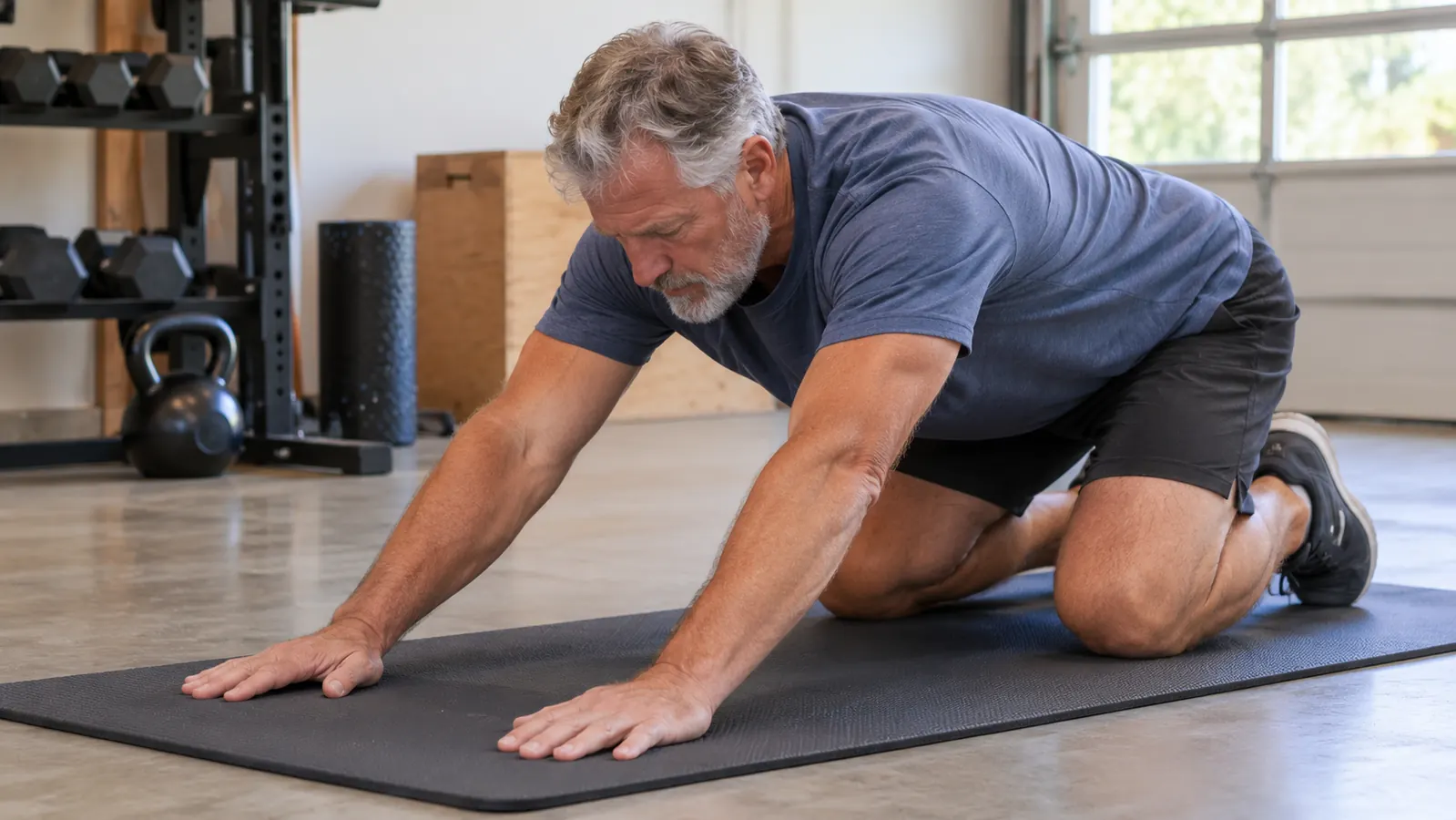
Six millimetres is a quarter inch. That is thinner than the big plush mats sold for pilates and much thicker than a folding travel mat. On my rubber tiles it feels like a firm cushion. Enough that my kneecaps, wrists, hips and spine stop complaining during supine work, and not so much that I feel like I am balancing on a mattress during single-leg drills.
The first thing I did when it arrived was kneel on it in the driveway in my work clothes, before I had even unrolled it properly, because I wanted to know whether 6mm was going to be enough. It was. I could still feel the concrete underneath it, definitely, but the sharpness was gone. Compare that to the foam mat, where I could have named the individual tile I was kneeling on. That is the whole difference in one sentence.
The place it matters most for me is my wrists. In a plank or a down dog my hands are planted and my wrists carry the load, and a hard floor sends that straight up my arms. With the Gaiam mat under me, that feeling is gone. It did not fix anything, to be clear. It removed one small irritation from my morning, and small irritations are the things that make people quit a routine in February.
The honest limit of 6mm is that it is padding, not suspension. If you have a knee that needs a lot of give, or you do a lot of kneeling work, you will want something thicker or you will want to fold a hand towel under the joint. I do the towel thing on my bad side. It works fine and it costs nothing.
The Sticky Surface, Tested by a Sweaty Woman in a Garage
The listing calls the surface sticky and textured. That is accurate in the way that actually matters. My hands stay where I put them in a plank. My feet do not skate backward in a down dog. And I have tested it under the least flattering conditions available to me, which is a Tulsa garage in July with a box fan moving hot air from one side of the room to the other.
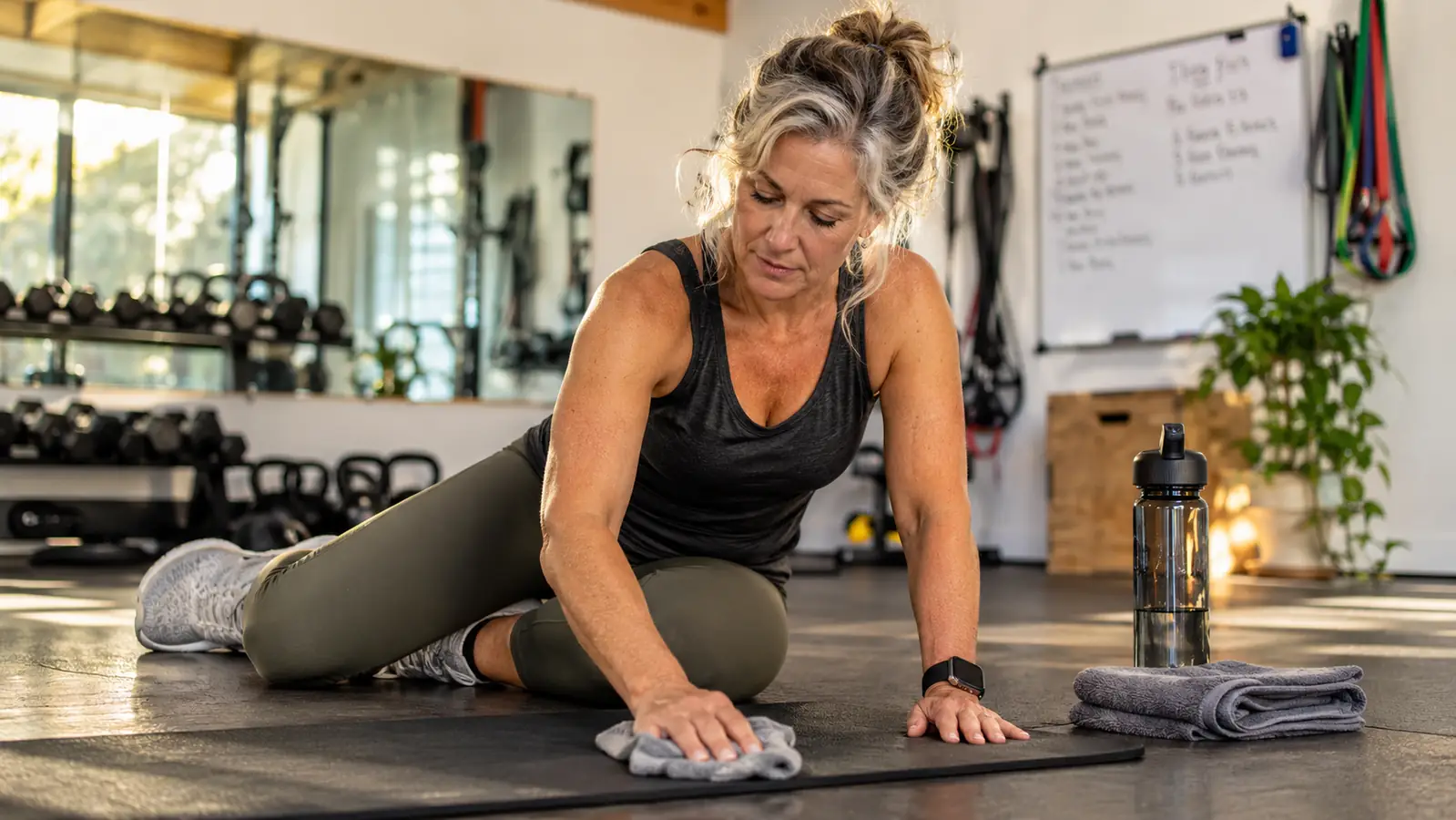
Here is a test I did not plan. In August I ran a Saturday session where the fan quit halfway through. Six people, a closed garage, no airflow. My hands were wet and I expected the mat to turn into a slip-and-slide by the second block. It got slicker, no question about it, but it stayed grippier than the foam mat did on a cool dry morning in April. I wiped it with a towel between blocks and it held for the rest of the hour. That is not a claim I could make about the mat it replaced.
One thing worth saying plainly: the grip comes from the texture, not from moisture. On a genuinely wet morning, sweat pools on any mat and grip degrades. I keep a hand towel at the edge of mine and use it between sets. That is not a knock on this mat. It is what floor work in an unconditioned garage is.
On carpet it behaves a little differently. It still grips, but the mat sinks slightly and the texture matters less. Two people in my Saturday group work out on carpet at home and both say theirs stays put. The one complaint I have heard is that on a plush carpet the edges can bunch during fast transitions between standing and floor work.
What Months of Regular Use Has Done to It
Nothing dramatic, which is the whole point. The surface has not pilled, cracked or gone shiny where my hands land. The edges have not curled up, and curled edges were the exact failure that killed the foam mat this replaced. The material is nitrile butadiene rubber, denser and heavier than the foam bargain mats, and that density is why it has held its shape through a season of being rolled, unrolled and stood on end.
I keep a running log on the whiteboard, mostly for programming my Saturday group, so I can tell you roughly what this mat has taken. Three or four mornings a week of my own work since spring, plus a Saturday session with about six people rotating through it, puts the total somewhere north of a hundred sessions. The corners still lie flat and the texture is still visible where I plant my hands. That is the number I would want if I were reading this instead of writing it.
The carrier strap it comes with is a sling, not a bag, and it does what a strap is supposed to do. I roll the mat, cinch it, and stand it in the corner by the whiteboard. For the first couple of months I carried it out to the driveway for Saturday sessions and it was fine at about 3 pounds. It is not a mat I would want to carry across a city, but across a driveway twice a week it is a non-issue.
Care is hand wash only, per the manufacturer. That means a damp cloth and a little mild soap, not the washing machine. I wipe mine down every couple of weeks and let it dry flat before rolling. I did once roll it up while it was still slightly damp and got away with it, but I would not make that the routine.
How It Compares to the Cheap Foam Mat It Replaced
The foam mat I had before was lighter and softer and it cost almost nothing, and for about six weeks it was fine. Then the surface went slick where my hands landed, the corners started curling up off the floor, and the whole thing began to feel like a rug that had given up. The Gaiam mat is heavier and firmer and it does not have either problem. It also does not fold into a little square, so if storage is tight, that is a real difference.
The trade is weight and density for stability. A firm mat on a hard floor is a more settled place to put your hands and knees, and that settled feeling is most of what you are paying for here. I noticed it most on the mornings when I was tired and sloppy, because a sloppy landing on this mat still lands. On the foam one, a sloppy landing meant my hand shot out from under me and I caught myself on a wrist. If you want the full breakdown of how a thin mat like this stacks up against a thick foam exercise mat for different kinds of work, that is a separate conversation and worth having before you buy either one.
The Tradeoffs I Would Tell a Friend About
First, the size. 72 by 24 inches is generous in length and standard in width. If you are taller than average, the length is the reason to pick this over a budget mat, and I know two people in my group who bought it for exactly that. If you are broad in the shoulders and you do wide stance work, 24 inches is not a lot of room and you will end up with a hand or a foot off the edge.
Second, the thickness cuts both ways. The same 6mm that protects your knees gives you less cushion for long seated work where you are on your sit bones. Again, a folded towel solves it and I keep one within reach.
Third, it is a rubber mat and it smells like one for the first few days. Unroll it somewhere ventilated before the first session. Mine aired out on the driveway over a weekend and then it was fine, and I have not noticed the smell since.
Fourth, hand wash only is a real constraint if you sweat heavily. Wiping it down becomes a frequent chore rather than a monthly one. I do it while I am cooling down, so it costs me about ninety seconds.
What I Liked
- 6mm of padding that genuinely helps knees and wrists on hard floors
- Textured surface holds hands and feet during planks and down dog
- 72 inch length fits taller people from head to toe
- Dense nitrile rubber has kept its shape, edges have not curled
- Carrier strap included, about 3 pounds to move around
Where It Falls Short
- 24 inch width is tight for wide stance work
- Hand wash only, so heavy sweaters will be wiping it often
- Rubber smell for the first few days
- Not enough cushion for long seated or kneeling work
The mat did not fix my knees. It removed one small irritation from my morning, and small irritations are what make people quit.
Who This Is For
Adults working out at home on a hard floor who want their knees, wrists, hips and spine to stop complaining during floor work. Beginners and returners especially, because the padding forgives an awkward landing and the grip forgives hesitating hands. If your routine is yoga, pilates, stretching, bodyweight strength or a low-impact class on a screen, this is a sensible, unglamorous choice that will not ask anything of you.
It also suits anyone taller than average who is tired of their heels hanging off the end of the mat. That 72 inch length is the reason several people in my Saturday group bought this one rather than something cheaper.
Who Should Skip It
If you need deep cushioning for a lot of kneeling or seated work, go thicker. If you want a mat to carry to a studio three times a week, go lighter. And if your training is wide, fast and athletic with a lot of lateral steps, the 24 inch width will frustrate you within a month.
One more. If the smell of rubber is a hard no for you, this is not the material for you. The Gaiam Essentials is nitrile butadiene rubber and it announces itself for the first few days before it settles down.
Buy it for the traction and the padding, not the portability
Months in, the Gaiam Essentials has held its shape, kept its grip, and stopped my knees from filing complaints on a hard garage floor. If that is the problem you are trying to solve, this solves it for a long time.
Amazon Check Today's Price on Amazon →