
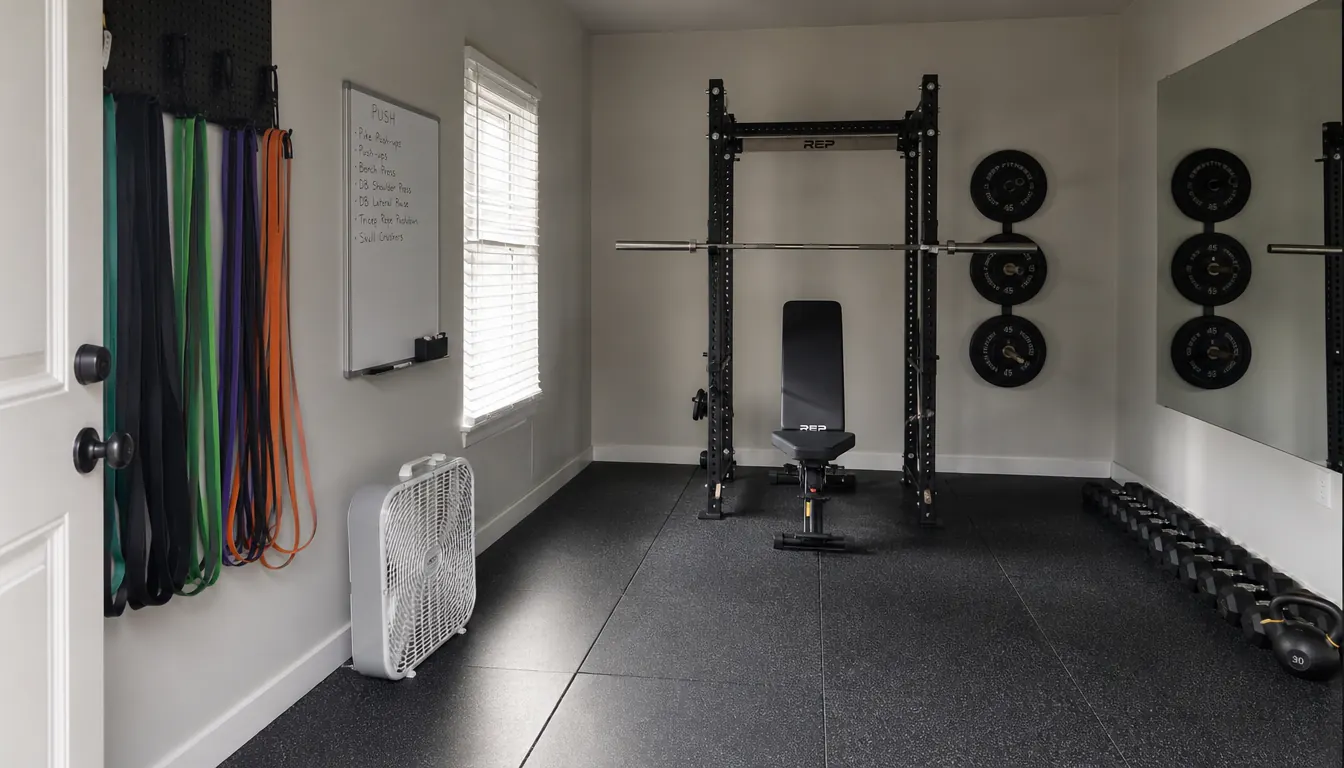
Half the people who walk into my garage gym for the first time ask about the squat rack. The other half ask about the thin rubber loops hanging on the pegboard by the door. Those loops are the Fit Simplify resistance bands, and if you have shopped for home workout gear in the past few years you have almost certainly seen them. Five latex loops, one small bag, an instruction booklet. What the product page does not tell you is that most people will use two of the five bands for years and ignore the other three, and that the set rewards one kind of buyer while quietly frustrating another. This is the review I give when a neighbor asks me in the driveway, and it is the review I would want if I were the one asking.
I am 52. I teach a small Saturday morning group out of a converted one car garage bay in Tulsa, and I have a right shoulder I injured years ago that I still warm up with care. My husband Ray is 58 and trains with me twice a week around a left knee that gives him trouble. Between the two of us and the six neighbors who show up on Saturdays, these bands have been pulled, stepped on, knotted, and left in the sun. Some of that was on purpose.
The Quick Verdict
A fair five band set for warm ups, hip and shoulder work, stretching and travel. The heaviest band will not replace a dumbbell, and the bands are not labeled, but the light and medium loops earn their pegboard space every single week.
Amazon Check Today's Price →The five loop set that earned its spot on my pegboard
Extra light through heavy, twelve inches by three, quarter inch latex, with a carry bag and an illustrated guide. Best for warm ups, hips, shoulders, stretching and travel. Not a replacement for weights.
Amazon Check Today's Price on Amazon →What Is Actually in the Bag
Five loop bands, each about twelve inches long and three inches wide, a quarter inch thick, made of latex. The whole set weighs three and a half ounces, so it disappears into a gym bag or a carry on. You also get a small drawstring carry bag and an instruction booklet with illustrated exercises. That is the entire product, and it is enough.
The five resistance levels run from extra light to heavy, and the listing describes the tension as heavy duty. In practice that means the top band is built for squats and pull patterns, not for delicate shoulder work. The bands are not marked in any way I could rely on. They come stacked in the bag in order, which works until someone in your house dumps them out, and then you are holding two loops up to the window trying to remember which one is medium. My Saturday group solved this with a permanent marker. It is not elegant, it works, and I should not have to do it.
The booklet is better than I expected and more generic than the photos suggest. It shows dozens of exercises, most of them variations on three ideas: band around the thighs, band around the ankles, band under a foot and pulled to the shoulder. If you already know how to use a loop band, you will flip through it once and put it in a drawer. If you have never used one, it is enough to get you moving without hurting yourself, which is more than most included guides manage.
The carry bag is a simple pouch with a drawstring. It will not survive a decade in the bed of a truck, but it keeps five loose loops from spreading across a drawer, which is the job.
How I've Used Them in a Real Garage Gym
The light band lives on the pegboard because I use it every session, usually before anything else. Banded pull aparts for my right shoulder, twenty slow reps, then some external rotations with the same band. That warm up has kept my shoulder quiet through years of teaching. A heavier band would let me cheat the range of motion, and cheating is exactly what got me hurt in the first place.
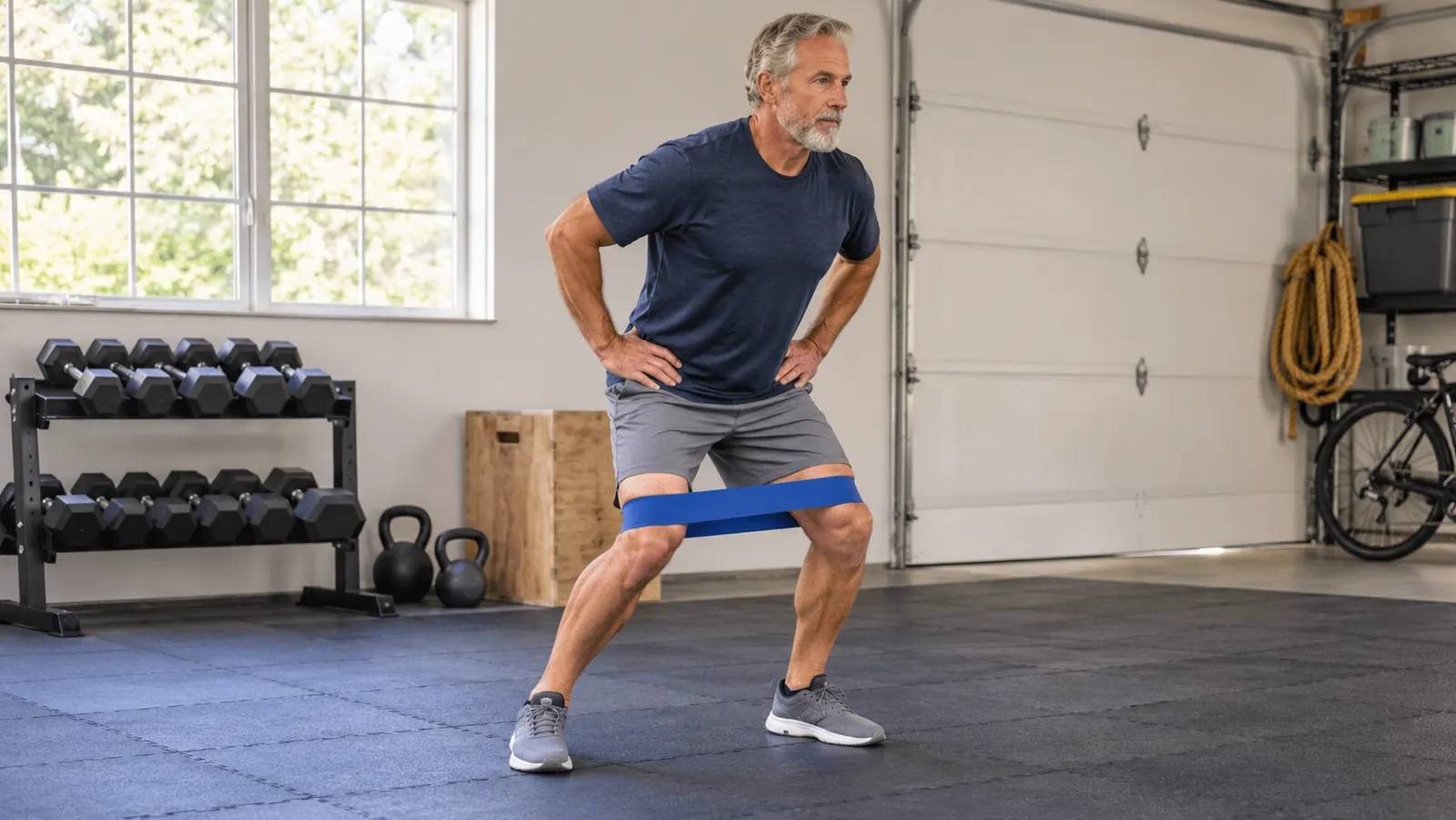
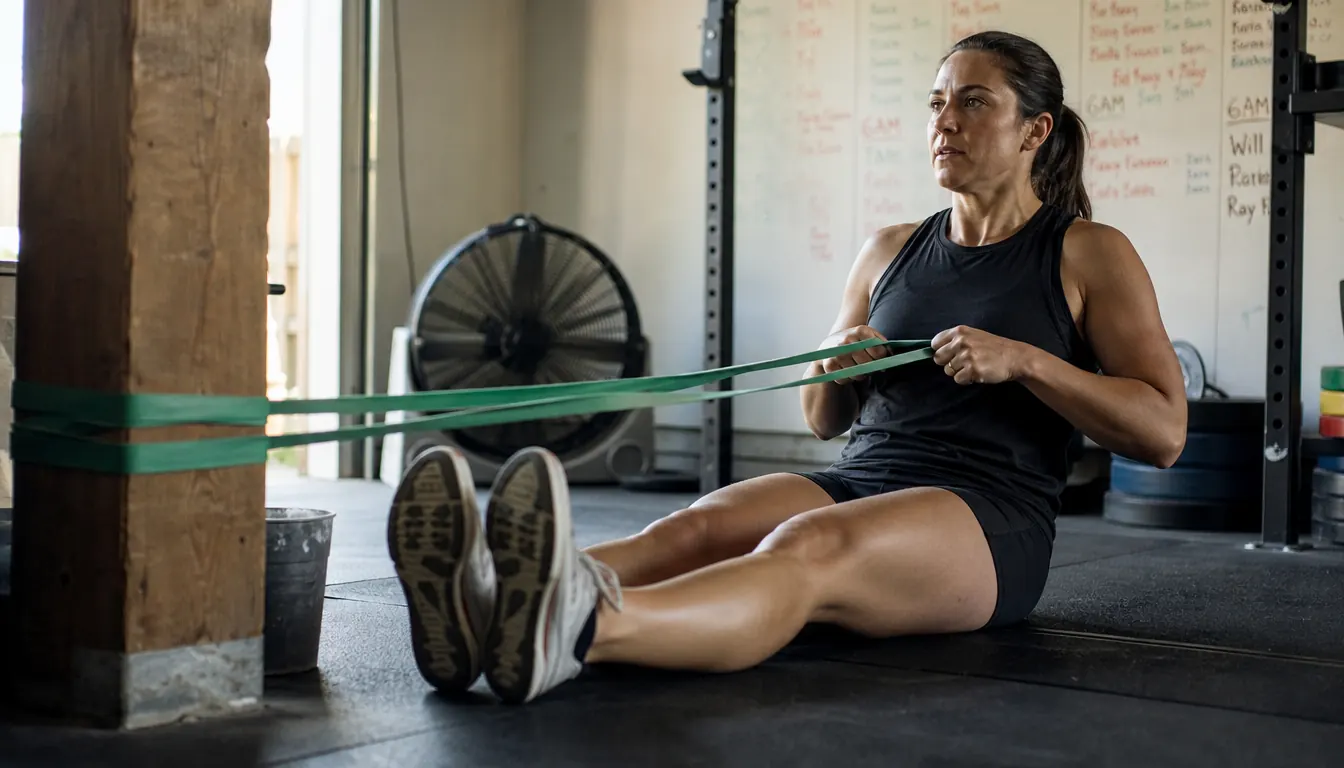
With Ray, the bands do what a bad knee actually needs, which is to let him load a small range of motion without a machine. Terminal knee extensions with the loop around a post, lateral walks with the band just above the knees, and some seated work. His knee is not fixed, and no band is going to fix it. What the bands give him is a way to keep moving on the days when the dumbbells feel like too much, and showing up twice a week matters more than the resistance on the band.
I have also used the extra light loop as a teaching tool. When a neighbor cannot feel her glutes during a bridge, a band above the knees gives her something to push against and the movement suddenly makes sense. That is a coaching trick, not a product feature, but it is the reason I keep a full set on the wall rather than one band in a drawer.
For the Saturday group, the bands come out in the circuit about twice a month. Hip work, monster walks, and a finisher where everyone stands on a band and does rows. Six people, five bands, one small argument about who gets the medium. Nobody has snapped one yet, and I have run enough sessions with cheaper bands to know that is not a given.
The Part Nobody Tells You: The Resistance Steps Are Not Even
Five levels sound like a smooth ladder. In the hand they are not. The gap between extra light and light is small enough that you may not notice which one you picked up. The gap between light and medium is the biggest jump in the set, and it is the one that surprises people. I have watched a neighbor go from a comfortable set of rows to a set she could barely finish by changing bands once.
The heaviest band is the one I touch least. It is stiff enough that it wants to roll and dig into the leg during anything smaller than a squat, and it is not heavy enough to stand in for a dumbbell for anyone who has been training for a while. If your plan is real strength work, you will outgrow this set faster than you expect. If your plan is warm ups, hip work, shoulder work, stretching and travel, the top end of the set is a bonus you will rarely need.
The practical version is this. Buy the set for the light and medium loops. Treat the extra light as a warm up tool and the heavy as a squat and deadlift accessory. Expect to buy a heavier band separately if you get serious about lower body strength. That is not a knock on Fit Simplify, it is how loop bands work at this resistance level, and a set that covers warm up through moderate work is still a fair trade.
One more thing about progression. Because the steps are uneven, moving up a level feels like a bigger jump than it is. When a movement gets easy with the light band, do not assume you are ready to live in the medium. Add reps first, slow the tempo down, and give yourself two or three weeks before you change anything. A band that feels too easy on day one is often the right band for a month.
Latex, Powder, and Tulsa Summers
These are latex, and that matters for two reasons. If you have a latex allergy, skip them. There are latex free loop bands that do the same job. Second, latex ages. Heat, sunlight, and the oil from your hands all shorten its life, and a garage in Oklahoma in July is not a kind place for rubber.
Mine came out of the bag with a light dusting of powder, which I wiped off with a damp cloth. The rubber smell faded in about a week. The powder is there so the loops do not stick to themselves in the package. It is not a defect and it is not a warning sign.
After a few summers, the oldest loop in my set picked up a small nick near the edge where it caught on a seam in the floor tiles. I retired it that day. A nicked band can let go without warning, and a band that lets go under tension is how people get hurt. Check the edges every few months. Store them out of direct sun. Do not leave one stretched around a post for weeks at a time. That advice applies to every band on the market, but a set at this level is easy to treat as disposable, and disposable is how people end up with a band that snaps at the worst moment.
What They Do Better Than Tubes With Handles
I keep tubes with handles too, and there is a place for both in a garage. Tubes with handles are easier to hold, easier to anchor in a door, and the better choice for anyone with grip issues or arthritis in the hands. Loops are better for anything that goes around a thigh, an ankle, or a foot, and for work where a handle would just get in the way.
The loop format is also harder to cheat. With a handle you can shorten your range of motion and still feel like you did something. With a loop around your ankles, either the band is taut and you are moving, or it is not and you are not. My group complains about monster walks more than any other exercise, and that is how I know the bands are doing their job.
The one job a loop does poorly is anchoring. There is no door strap in the bag, so if you want to do rows or presses with a loop you are wrapping it around a post, a railing, or a sturdy piece of furniture and hoping it stays there. Tubes with handles come with a door anchor and that makes them the more convenient tool for pulling movements from a doorway.
Choose based on the movement, not the star rating. Hip and glute work, warm ups, physical therapy style exercises, stretching and travel: loops. Rows, presses, bicep work, and anyone who needs a handle to hold: tubes. Most home gyms end up with both, and that is fine.
The Small Annoyances That Add Up
Loop bands roll. On a thigh, a calf, or a bare ankle, the band finds a way to fold itself into a thin rope and pinch. It happens with every flat band, and it happens with these. A pair of shorts or tall socks helps, and so does moving the band an inch higher or lower than where it rolled.
The missing labels are the real annoyance. Five loops in one bag and no way to tell medium from heavy without holding them side by side is a small design failure, and it is the one thing I would change about the Fit Simplify set. A stitched line, a printed number, a colored edge, anything. My marker trick works. I should not need it.
What I Liked
- Five levels, extra light through heavy, that cover warm up, hip work, shoulder work, stretching and travel
- Twelve inches by three and a quarter inch thick, so they stay put on the leg better than skinny loops
- Three and a half ounces for the whole set plus a carry bag, which makes them a genuine travel option
- The illustrated booklet is enough for a beginner to start safely without a trainer
- The latex has held up to twice weekly use for years, which is more than I can say for cheaper loops I have snapped
Where It Falls Short
- Latex, so anyone with a latex allergy should look elsewhere
- No labels on the bands, so telling medium from heavy means comparing them side by side
- The jump from light to medium is bigger than the names suggest
- The heaviest band is too stiff for small joint work and not heavy enough to replace weights
- Flat bands roll and pinch on bare skin during leg work
Six people, five bands, one small argument about who gets the medium, and nobody has snapped one yet.
Who This Is For
Buy these if you are new to resistance work, or coming back after time off, and you want one small purchase that covers warm ups, hip and glute work, shoulder work, stretching and travel. Buy them if you coach friends in a garage and need six people doing the same circuit without six machines. Buy them if a physical therapist has you working with light resistance at home and the band you were given is ready to retire.
They are also a good fit if you are the person who does ten minutes of hip work before a walk, or the person who wants something to do in a hotel room. Mine go in a suitcase and I do hip work on the carpet, which is more than I can say for the dumbbells. If your goal is to move a little better and feel less stiff on Sunday morning, this set covers that ground.
Who Should Skip It
Skip these if you have a latex allergy. That is not a small caveat, it is a deal breaker, and latex free options do the same job.
Skip them if you are already strong and want to train strength seriously. At this resistance level the set is a warm up tool for you, not a program. A single heavy band or a pair of adjustable dumbbells will serve you better, and you probably already know that.
Skip them if you have grip or hand issues and your main goal is rows and presses. Tubes with handles are more comfortable for that work, and there is no reason to fight a flat band when a handle exists.
And skip them if you want a structured plan. The booklet shows exercises, not a program. If you need someone to tell you what to do on Tuesday morning, this set will live in the bag and you will be back to searching for a plan by February.
The set I hand to neighbors who ask what to buy first
Five latex loops, extra light through heavy, with a carry bag and an illustrated guide. Best for warm ups, hips, shoulders, stretching and travel. Skip it if you have a latex allergy or want to lift heavy.
Amazon Check Today's Price on Amazon →