
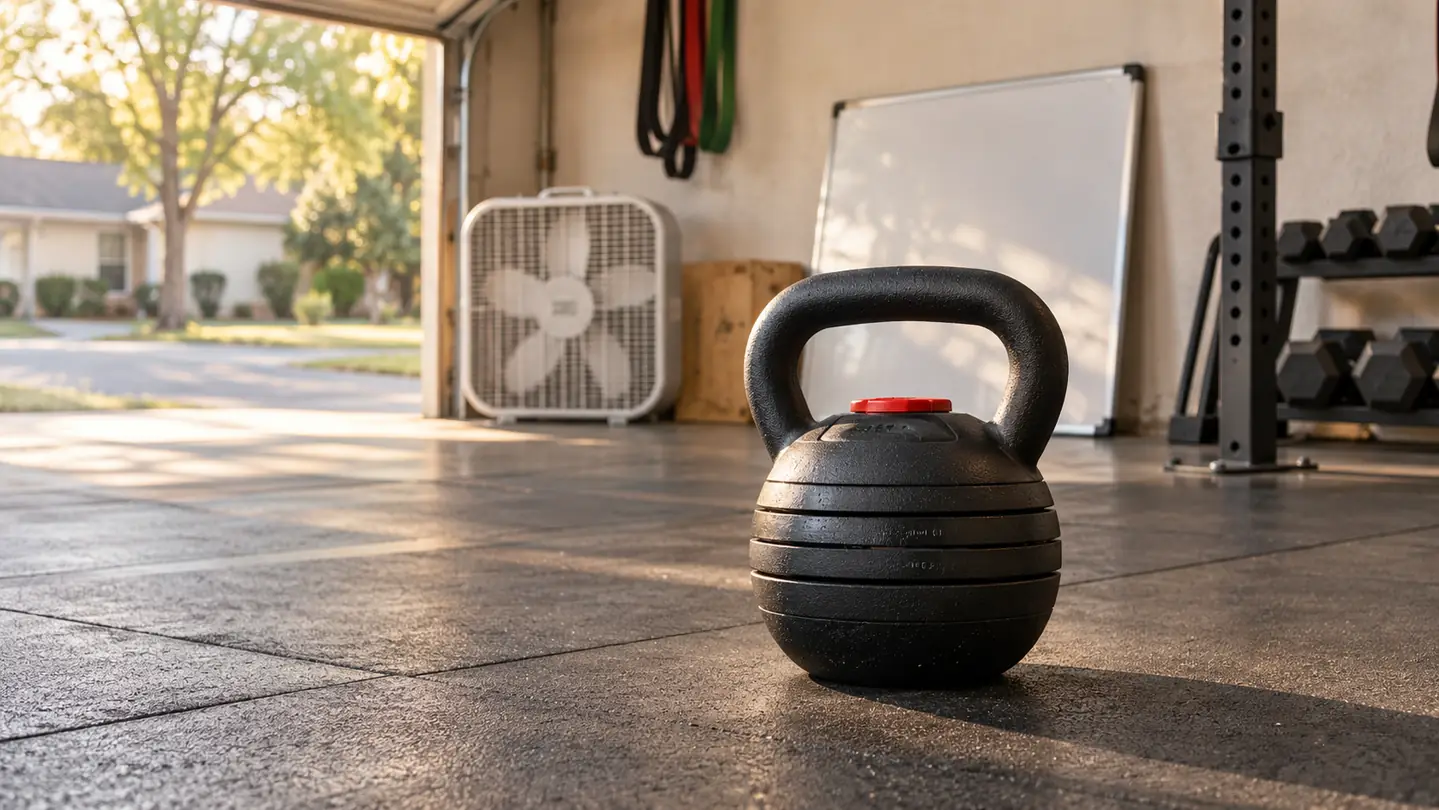
I bought the Bowflex SelectTech 840 in March, mostly because my garage had about one square foot of floor left and a rack of six cast iron kettlebells was not going to fit in it. I teach a small Saturday morning group out of that garage, six neighbors who show up with coffee cups and varying degrees of enthusiasm, and for two years I had been carrying my own bells in from the house and back out again. My right shoulder is held together with stubbornness and a ten minute warm-up, so I am picky about handles. A kettlebell that hurt to hold would have been a waste of floor space.
Here is the short version before the long one. The Bowflex 840 is one bell that does the job of six, from 8 pounds up to 40, and you change the weight with a dial instead of a wrench and a pile of plates. It has been in weekly use in my garage for months now: by me at 52, by my husband Ray at 58 with a left knee that complains about everything, and by whoever in the Saturday group wants a lighter bell for rows. It is not perfect. There are two things about it I would change tomorrow if I could. But it has earned its floor space, and that is the highest compliment I can give a piece of equipment.
The Quick Verdict
One bell, six weights, no rack. The dial is genuinely quick, the handle is kind to sore shoulders, and 40 pounds is the honest ceiling. If you are not swinging heavier than that, this replaces a whole corner of your gym.
Amazon Check Today's Price →Six Kettlebells Fit in Eight Inches of Floor
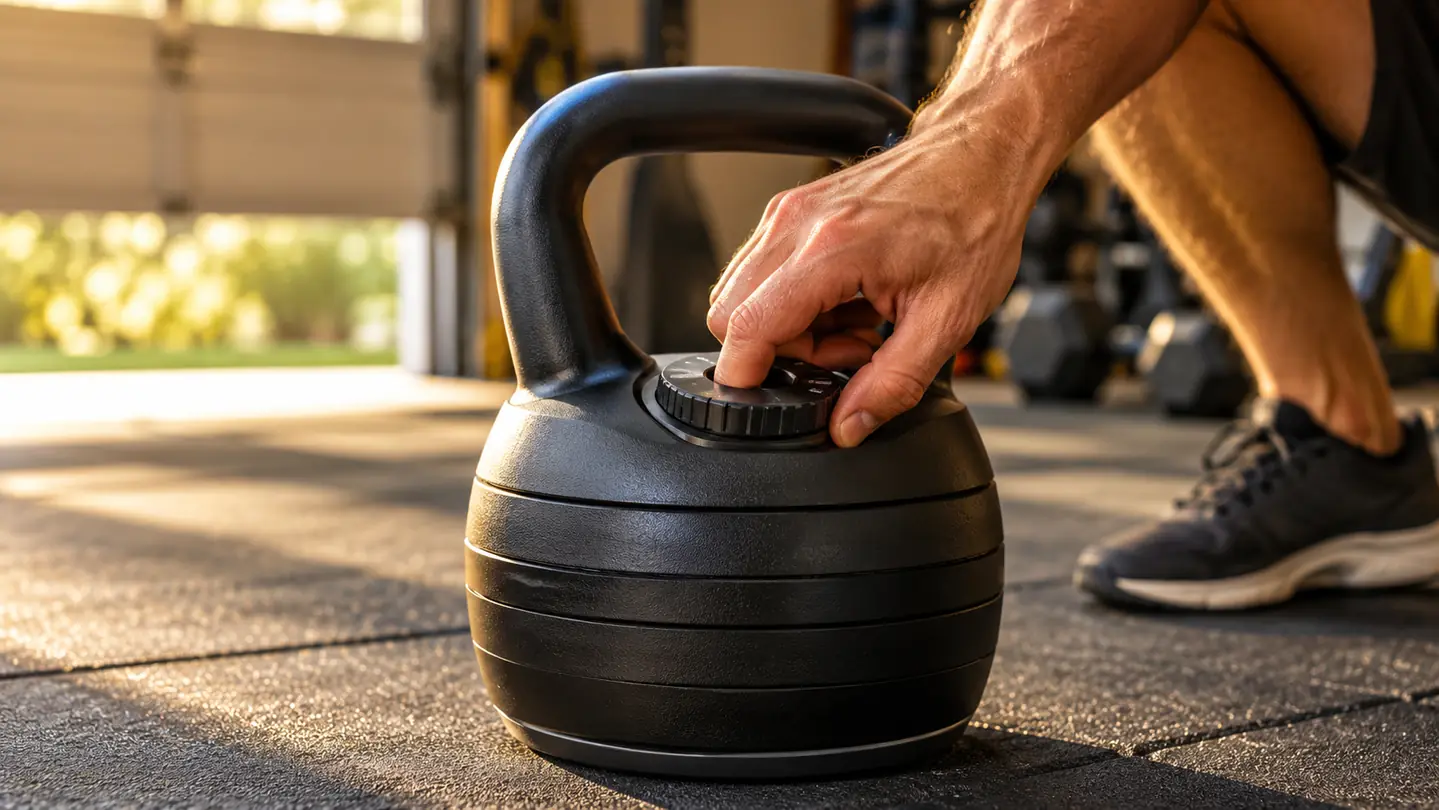
The dial moves from 8 to 40 pounds in a few seconds, so there is no rack, no clatter, and no walking across the garage in the middle of a set.
Amazon Check Today's Price on Amazon →How I've Used It
The 840 lives on a rubber tile at the front of the garage, next to the fan. It comes out four mornings a week for me and twice a week for Ray, and on Saturdays it gets passed around the group. A typical week for me is swings, goblet squats, rows, and a twist or two on the days my shoulder is behaving. That is not a fancy program. It is the kind of program a 52 year old with a bad shoulder and a full calendar can actually keep, and it is exactly the kind of program this bell was built for.
Ray is the real test case. He had never touched a kettlebell before this year and he has a left knee that does not like deep anything, so we started him at 12 pounds for squats and 20 for rows. He is up to 25 on rows now. The fact that I could move him up without buying him a single new weight is the whole argument for an adjustable bell, and I did not have to think about it. I just turned the dial while he caught his breath. The first month he used it twice a week and skipped any week the weather turned cold, because the garage door stays open and he is a fair weather lifter. By June he was asking to go out there on his own, which is the surest sign a piece of equipment stopped being homework.
My shoulder is the other test case. A 28 mm handle does not sound like much to get excited about until you have gripped a thick, chalky cast iron handle with a shoulder that is already annoyed at you. The handle on the 840 is rubber over metal, which is easier to hold onto than bare steel and does not shred my hands during high rep sets. Before this bell I had a cheap cast iron one I bought at a yard sale, and I gave up on it after maybe six weeks because my grip would fail two reps before my back did. That is a frustrating way to train. I still warm up for ten minutes and I am not going to pretend a kettlebell fixed anything, but I can finish a set of rows now without stopping to shake my hand out, and that changed how often I did rows at all.
One morning in April I timed the transitions out of curiosity, because I had been telling the group the dial was faster and I wanted to be sure I was not exaggerating. Twelve swings at 40, then down to 25 for a set of rows. Dial turn to first rep took me about six seconds, and half of that was me setting my feet. Walking to the house for the lighter bell and back used to cost me close to a minute and a half, and I would usually just do the rows heavy instead. Six seconds versus ninety is the whole case for this bell in one number.

The Dial Does All the Work
You turn a dial and the weight changes. That is it. No pin to pull, no plates to slide on, no wrench. The settings are 8, 12, 20, 25, 35, and 40 pounds, so in practice you are picking from those six and nothing in between. I can change it while standing over the bell between sets, which sounds lazy and is in fact the entire point. The home equipment that gets used is the equipment that does not require a project in the middle of a workout.
Bowflex says you can switch rapidly from one exercise to the next, and after months of use I would call that fair. It takes me a few seconds. Not one second, not instant, but a few, and I have never lost my rhythm waiting on it. What I have done is stop dreading the transitions in a circuit. When I had to walk across the garage to swap bells, I would quietly shave reps. Now I do not, because there is no walk.
The one thing the dial does not do is give you 30 pounds. The settings skip from 25 straight to 35, and there is a real jump there. If 30 is your number for a particular lift, you are choosing between a set that is too easy and a set that is a grind. For me that has mattered most on overhead presses and least on swings. Presses are where I feel it, because 25 gets easy fast and 35 is still a fight on my right side. It is a small annoyance in a piece of equipment that solves a much bigger problem, but it is real and you should know it going in.
What 8 to 40 Pounds Actually Covers
Forty pounds is a lot for some lifts and not much for others. For goblet squats, rows, presses, twists and carries, 40 is plenty for most people who train at home a few times a week, and the 8 pound setting is light enough for a true beginner or for careful rehab style work. For swings, 40 pounds is a beginner to intermediate weight. Ray swings the 35. I swing the 40 and would happily swing heavier if the bell went there. If you are a strong person who has been swinging a 55 for years, this is going to feel like a step down, and no dial is going to fix that.
The Saturday group is a decent sample. Six neighbors, mixed ages, mixed fitness, one of whom had never done a kettlebell row in her life. With one bell on the floor I can hand out 8, 12, 20 or 25 pounds depending on who is standing there, and I am not dragging six pieces of iron out of a closet. That flexibility is worth more to me than any single weight on the dial. It is the difference between a workout that fits the person and a person who has to fit the workout. I also stopped keeping a clipboard of who gets which bell, because there is only one bell and the answer is always the same bell.
Where it surprised me was the small accessory work. Twists, halos, single arm carries, that sort of thing. Having a light 8 pound setting right there means I actually do the shoulder prep I am supposed to do instead of skipping it because the light bell is in the house. I do not want to oversell that. It is a convenience. But convenience is what makes a warm-up happen on a Tuesday when you are tired, and I have had a lot more of those Tuesdays this year than I would like to admit.
Six cast iron kettlebells take up as much floor as a coffee table. This one takes up 8.82 by 7.01 inches, and it never rolls anywhere.
The Handle, the Footprint, and the Small Stuff
The footprint is 8.82 inches long and 7.01 inches wide. That is roughly the size of a large shoebox, and it is the reason I bought the thing. My old bells lived in a row along the wall and I was forever stubbing a toe on one. The 840 sits in one spot on a flat base, so it does not roll, does not wander, and does not need a rack. In a one car garage that also holds a fan, a whiteboard, a mirror and a rubber floor, that matters more than any spec sheet number.
The handle is rubber over metal at 28 mm, which is on the friendlier side for smaller hands. The Saturday group has a couple of people with hands that are not large, and nobody has complained about the grip. The body is a composite material rather than cast iron, so it does not have that dense, dead feel of a classic bell. It is quieter on the floor, which Ray appreciates at 6:15 in the morning, and it does not scuff the rubber tiles. My tiles are the interlocking kind that show every mark, and after months of being set down hard four days a week there is not a scuff where the bell sits.
The warranty is two years. I have not had to use it, and after months of weekly use nothing has loosened, rattled, or stuck. The dial still clicks through its settings cleanly, and I have never had a plate hang up halfway through a change. I check the mechanism about once a month the way I check everything in the garage, and so far there has been nothing to check. That is not a dramatic endorsement. It is the endorsement you want from equipment you plan to keep for years.
The one design tradeoff worth flagging is the shape of it in your hand. An adjustable bell is a bigger object than a fixed bell of the same weight, because the plates have to live somewhere. That shows up most on cleans and snatches, where the bell comes to rest against your forearm. I do swings, squats, rows and twists, so it has never bothered me once. If your program leans hard on cleans, try one before you commit, because no review can tell you how it will sit on your particular arm.
What I'd Change
Two things. The first is that 25 to 35 jump. A 30 pound setting would make the Bowflex 840 work for a much wider range of people on overhead work. The second is that 40 pounds is the ceiling. There is a real group of home lifters, and I am one of them on swings, who would pay for a version that went to 50 or 55. Those two complaints are the reason this is an 8.6 and not higher. Everything else about the bell does exactly what it says it will do.
I will say the second complaint out loud to anyone who asks, because it is the one that will eventually retire this bell from my garage. I am 52 and I would like to still be swinging something in ten years. When 40 pounds stops being a challenge on swings, which it will, my options are to swing it faster or to buy a second bell for that one lift. That is a fine problem to have and it is a long way off. But it is honest, and the honest version is more useful to you than a review that pretends a dial solves everything.
What I Liked
- Six weights in one bell: 8, 12, 20, 25, 35 and 40 pounds, changed with a dial
- Takes up 8.82 by 7.01 inches of floor and does not roll or wander
- 28 mm rubber over metal handle is easy on sore hands and shoulders
- Quiet on rubber tiles, which matters at 6 in the morning
- No rack, no plates, no wrench, no trip to the sporting goods store
- Two year warranty and nothing has loosened through months of weekly use
Where It Falls Short
- No 30 pound setting, and the 25 to 35 gap is a real jump
- 40 pounds is the ceiling, so strong swingers will outgrow it
- The composite body does not feel like cast iron
- Bulkier in the hand than a fixed bell of the same weight
Who This Is For
This is for the person who trains at home in a spare room, a garage, or the corner of a living room, and who wants one piece of equipment instead of six. Beginners will get years out of it because 8 pounds is genuinely light. People coming back after a long break will get years out of it because the middle settings cover the rebuild. Anyone coaching a mixed group out of a small space will get years out of it because one bell serves everybody in the room. If your program is squats, rows, swings, presses, carries and twists, this covers all of it, and you can do the whole thing without rearranging your furniture.
It is also for the person who has tried the other thing first. I spent a winter doing swings with a pair of dumbbells I already owned, because I told myself a kettlebell was a gadget and I could get the same work done for free. What actually happened is that the dumbbell handle beat up my forearm on swings, the plates knocked together, and I stopped doing swings by February. The 840 is the reason swings came back into my week. That is not a knock on dumbbells, which do plenty of things well. It is just that a bell is shaped like a bell for a reason, and my forearms noticed.
Who Should Skip It
Skip it if you already swing heavy. If 55 or 70 pounds is your working weight for swings, the 840 will be a warm-up tool at best and you will be frustrated within a month. Skip it if you do a lot of cleans and snatches and you care how a bell sits against your forearm, because an adjustable bell is a different shape in the hand than cast iron. And skip it if a 30 pound setting is load bearing for your program, because it is not there. None of those are knocks on the bell. They are just the edges of what it was built to do.
One Bell, Six Weights, One Square Foot of Floor
I have used the Bowflex SelectTech 840 four mornings a week for months. It has not loosened, it has not rolled away, and it has never once made me walk across the garage to find a different weight.
Amazon Check Today's Price on Amazon →