
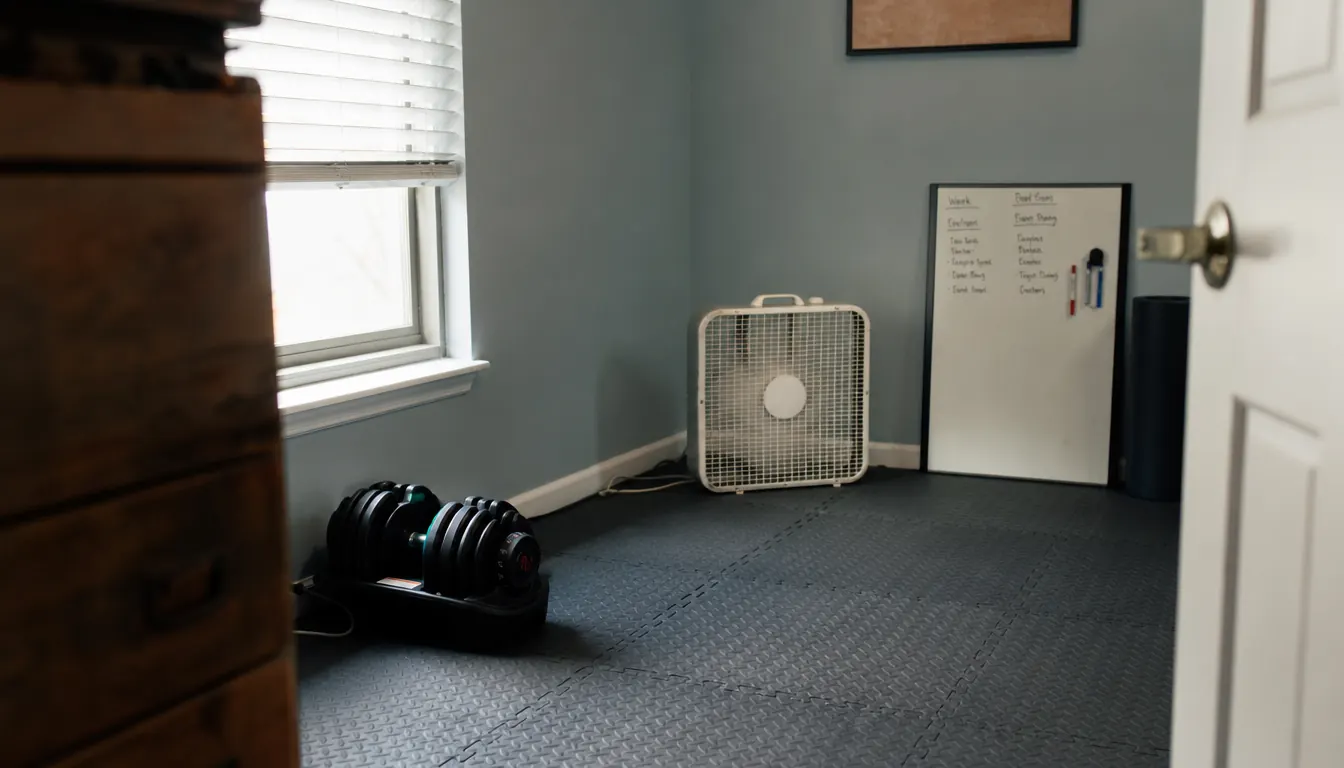
The spare room in my house is nine feet by eleven, and a folding table eats a third of it. That leaves a rectangle of floor big enough for one person and one set of Lifepro adjustable dumbbells, which is exactly what has been living there for the better part of a year. In that rectangle I have watched about six neighbors, my husband Ray included, go from nervous beginners to people who actually look forward to Tuesday. Not one of them needed a bigger room. They needed someone to tell them what to do on Tuesday, in what order, and with how much weight.
Here is the pattern I see over and over. Someone buys adjustable dumbbells because the idea of a home gym appeals to them and the adjustable part promises a whole rack of weights in one footprint. Then the dumbbells arrive, they do a few sets of curls in front of a mirror, and by week three the whole thing is a very heavy doorstop in the corner. The equipment is almost never the problem. The plan is. Nobody wrote down a session that fits in twenty-five minutes and does not require a bench, a spotter, or a personality transplant. So here is the plan. Five steps, one spare room, one dial.
The weight worth having is the weight already sitting in the room
The Lifepro adjustable dumbbell runs from 5 to 25 lbs in 2.5 lb increments on a quick-adjust dial, so one compact piece covers a nervous beginner and a returning lifter in the same corner of floor. Alloy steel build, secure locking mechanism, textured non-slip grip, and a storage rack that keeps the rectangle clear.
Amazon Check Today's Price on Amazon →Step 1: Claim a rectangle, not a room
You do not need a gym. You need roughly the footprint of a yoga mat, plus enough clearance to swing your arms out to the sides without putting a hand through a lamp. Put the dumbbells at one end of that rectangle and a sturdy chair at the other and you have a gym. The Lifepro unit measures 13.6 inches long and 6.7 inches wide, so a two foot square of floor holds it comfortably with room to set it down between sets.
The storage rack earns its keep more than it sounds like it would. Mine sits against the baseboard, which means I step over nothing and pick up nothing off the carpet while hunched over in socks. If you have ever tried to lift a dumbbell off a soft floor first thing in the morning, you know exactly why I am fussy about this.
Then look up and to the sides before you commit. Ceiling height matters if you plan to press overhead, and a lot of spare rooms have a light fixture sitting right where your hands want to go. Measure it with a tape rather than your eye, because a room that looks tall enough from the doorway is often a different story directly under the fixture. Ours came in at just over seven feet at the highest point and closer to six and a half under the light, which is why the overhead press happens one step to the left. That sounds fussy until you are the person with a knuckle that hurts for a week. Two minutes with a tape saves that entirely.
Move the rectangle rather than ducking under the problem. Ray cleared out a shelf and a bicycle before we ever lifted a weight, and that one hour of clearing is the reason the space still gets used.

Step 2: Set the load before your hands leave the rack
The Lifepro dumbbell uses a quick-adjust dial that goes from 5 to 25 lbs in 2.5 lb increments, and that range with that step size is the most useful thing about it for a beginner. Five pounds is a genuine starting weight for a shoulder press. Twenty-five is a genuine working weight for a row. The 2.5 lb steps in between mean you are never stuck choosing between a weight that is too easy and a weight that stalls you out for a month.
Build one habit before anything else: dial the weight, lift the handle, and confirm the dumbbell is set where you meant before you start the set. Do it every time, including the last set when you are tired and tempted to skip the check. The locking mechanism is designed to hold the load secure and the textured non-slip grip is designed to keep it in your hand, but neither of those does you any good if you rushed the dial.
Set the weight before you pick it up, not during the set. I say that because I once watched a neighbor decide mid-session that he could be clever about it, and he spent the rest of the workout with a dumbbell that felt wrong in his hand. Learn from his quiet confusion.
Step 3: Pick five patterns and stop adding exercises
You need one squat, one hinge, one push, one pull, and one carry. That is the entire list. With the Lifepro dumbbell you can load a goblet squat, a Romanian deadlift, a floor press or a shoulder press, a bent-over row, and a suitcase carry down the hallway, and cover essentially every major muscle group. The listing claims whole-body use and with those five patterns that claim holds up.
If a movement bothers a joint, swap it within the same pattern rather than dropping the pattern. A shoulder that dislikes pressing overhead can press from the floor instead. A knee that complains about a deep goblet squat can squat to a chair and stand back up. The pattern stays, the version changes, and you keep training.
A starting session looks like this. Goblet squat with 10 lbs. Romanian deadlift with 15. Floor press with 12.5 in each hand if you have the pair, or one arm at a time if you have a single. Bent-over row with 15. Suitcase carry with 20 down the hall and back. Three sets of each, eight to twelve reps, which lands at about twenty-five minutes once you include the rest you will take whether you planned to or not.
Five exercises, not fifteen. This is the part people push back on. Adding a sixth, seventh and eighth movement feels productive, but it usually just means you are worn out by the time you reach the ones that actually matter. Sit with the same five for four weeks before you change anything at all.
Step 4: Progress in 2.5 pound steps, not by feel
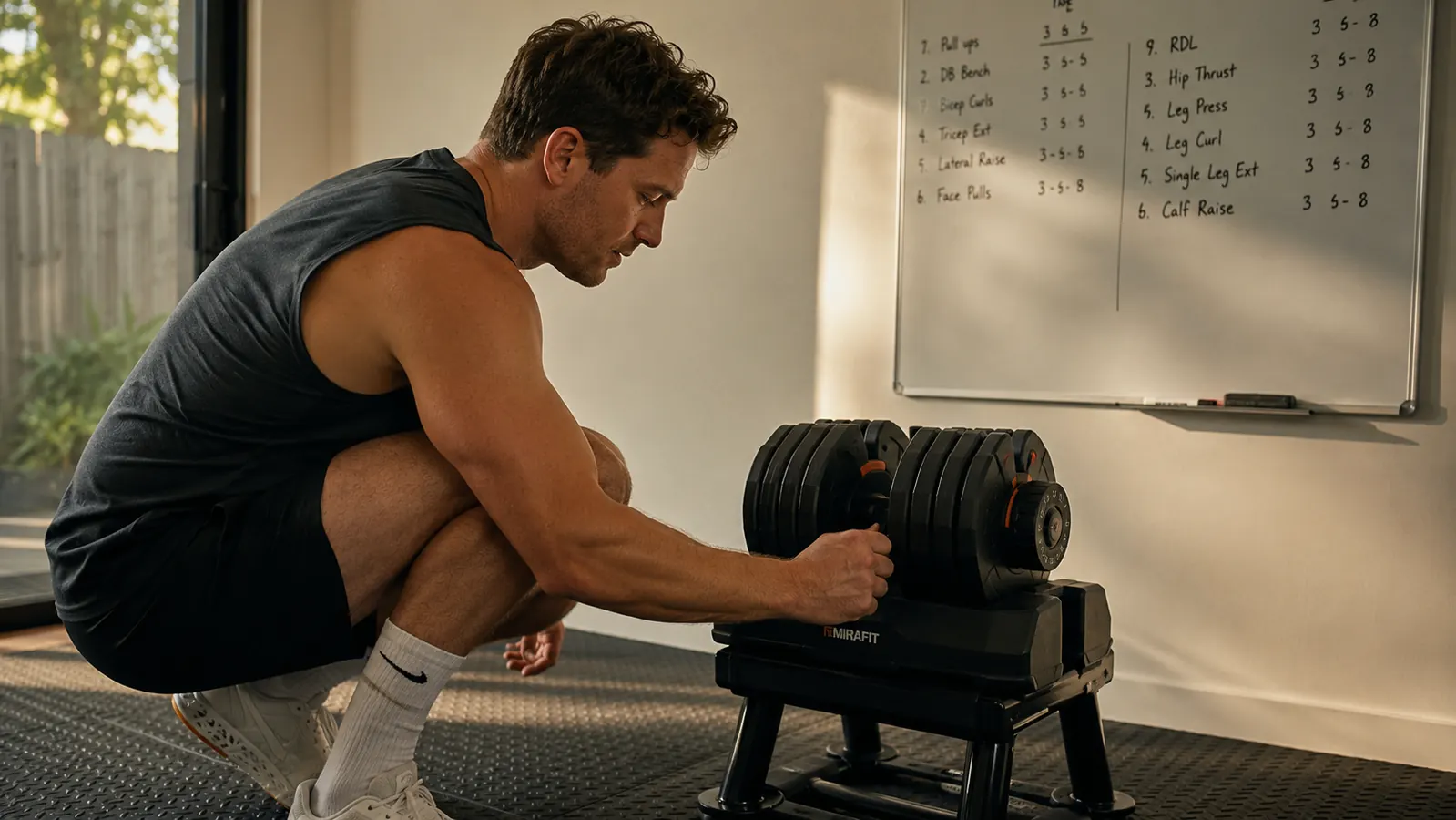
Here is what adjustable dumbbells give you that a rack at the gym does not: the ability to go up by 2.5 lbs. In a commercial gym the next dumbbell is five pounds heavier, so people spend months swinging between slightly too light and completely defeating. At home, with a dial, you can add 2.5 and barely notice, which is precisely the point. Small jumps are how beginners keep moving for years instead of weeks.
My rule for the Saturday group is simple. When you finish every set and every rep, and the last rep of the last set still looked like the first rep, go up 2.5 lbs next session. Not before that. And never more than one step at a time, no matter how good you feel in the moment.
Write the number on the whiteboard the moment the set ends, not at the end of the session. I started requiring this after a Tuesday where three of us finished, felt great, and then could not agree on what anyone had actually lifted. The board settled it. Fifteen pounds, not twenty. Nobody's memory is as good as they think it is at the end of a workout, mine included.
I will be honest about where this set stops. Twenty-five pounds per dumbbell is plenty for shoulders, arms and most upper-body work for a good long while. For legs, it is light. Once a goblet squat with 25 lbs feels easy, you have outgrown what this dumbbell can load, and you will need tempo work, single-leg variations, a second dumbbell, or a heavier option. Ray hit that wall around month five. His left knee does better with slow, controlled squats than heavy ones anyway, so we slowed him down rather than loading him up, and he is still at it.
Step 5: Put it on the calendar and make it boring
Three sessions a week, twenty-five minutes each, at a time you will genuinely show up. For my Saturday group that is 8 a.m. in the garage bay. For Ray it is Tuesday and Thursday after the news. For you it might be Monday, Wednesday and Friday before your shower. The specific days matter far less than the fact that they are chosen in advance and written somewhere you will see them without hunting.
Boring is the goal. The people I have watched stick with this for a year are not the ones who found the most exciting program. They are the ones who did roughly the same five exercises, with slowly climbing weight, while half listening to a podcast. Novelty is fun for two weeks. Repetition is what builds strength.
Start every session with four or five minutes of easy movement before you touch a working weight. I wrecked my right shoulder years ago and I am careful with it now, so I do shoulder circles and a couple of very light press sets before anything counts. Ray does five slow sit-to-stands off the chair for his knee. It feels like nothing. It is the reason we are both still training.
And when you miss a week, which you will, do not restart from zero. Drop 2.5 lbs on your two hardest exercises, do the session, and carry on. The goal is to still be doing this in March, not to have a perfect record in January.
My Saturday group started at 5 lbs on the press. By week eight most of them were at 12.5, and the only things that changed were the dial and the calendar.
What Else Helps
Flooring, a mirror, and moving air. I have rubber tiles in the garage bay because concrete is unforgiving on knees and hips, and one wall mirror so I can see whether my row is actually a row or a small back spasm waiting to happen. A box fan in the corner makes a twenty-five minute session in July in Tulsa genuinely pleasant. None of it is expensive or complicated, and all of it makes showing up a little easier.
Beyond the dumbbells, keep the kit minimal. A sturdy chair or a low bench for the floor press and for sitting between sets. The timer on your phone so three sets do not quietly become thirty minutes. A small whiteboard on the wall where you write the weight you used for each of the five exercises, because your memory for numbers is far worse than you believe. I have had neighbors swear they pressed 20 lbs the week before when the board plainly said 15.
Two last practical notes. Keep the dumbbell on its rack between sets rather than on the floor, both to spare your lower back on the pickup and to keep the rectangle clear so you are not stepping around it all session. And write the whole plan down somewhere visible, all five exercises with your starting weights, because a plan in your head is a plan you will renegotiate at 6 a.m. when the couch looks comfortable.
One dial, one corner of floor, three mornings a week
The Lifepro adjustable dumbbell covers 5 to 25 lbs in 2.5 lb steps with a quick-adjust dial, an alloy steel build, a secure locking mechanism, a textured non-slip grip, and a storage rack that keeps your training rectangle clear. It will not replace a barbell for heavy leg work, and it does not need to. It replaces the doorstop.
Amazon Check Today's Price on Amazon →